Quick Answer 🔥
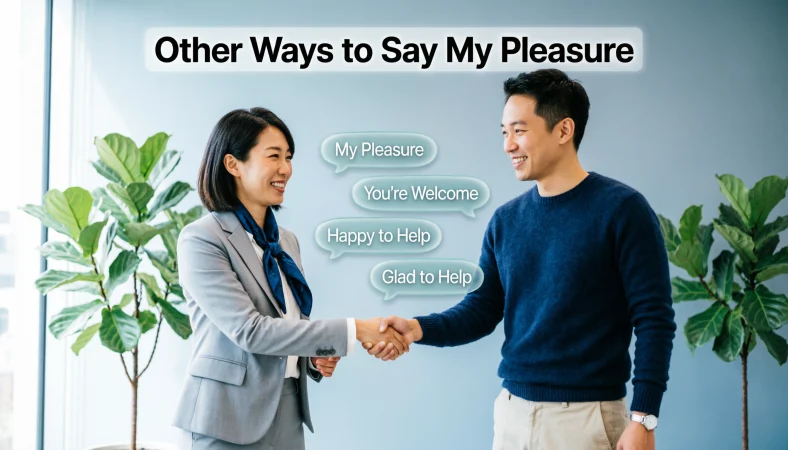
If you’re looking for other ways to say “my pleasure,” some natural alternatives include you’re welcome, happy to help, glad to help, anytime, no problem, and it was my pleasure. The best choice depends on whether you’re speaking casually, professionally, or formally.
“My pleasure” is one of the most common responses to “thank you” in English. It signals that you genuinely enjoyed helping and that the favor was never a burden. You’ll hear it everywhere from coffee shops to corporate meetings.
But using the same phrase repeatedly can make you sound robotic, overly formal, or even outdated. That’s why learning alternatives to “my pleasure” is essential for anyone who wants to sound fluent, natural, and context aware. Whether you need to express excitement in English, respond professionally in an email, or keep it casual with friends, having a variety of replies at your disposal builds confidence and credibility.
“The right tone makes your English sound professional and confident.”
Quick Categories
Formal Alternatives to “My Pleasure”
- It was my honor
- The pleasure was mine
- I’m delighted to help
- It was my privilege
Casual Alternatives
- Anytime
- No worries
- Don’t mention it
- Sure thing
Professional Alternatives
- Happy to assist
- Glad to be of service
- Always happy to help
- I’m pleased to support
Informal Expressions
- No problem
- You got it
- Of course
- It’s all good
What Does “My Pleasure” Mean?
“My pleasure” is an idiomatic response to “Thank you.” It means you were happy to help and that the task or favor brought you satisfaction, not inconvenience. It is similar to “You’re welcome” but more polite and more emphatic.
Grammar note: It is a shortened form of “It was my pleasure.” You can use both interchangeably.
Example: “Thanks for picking up my package.” “My pleasure.”
When to Use “My Pleasure”
Use “my pleasure” when:
- Responding to a thank you in customer service or hospitality
- Acknowledging gratitude in professional settings
- You want to sound warm and polite
- You genuinely enjoyed helping
- The situation calls for a service oriented tone
Spoken vs Written: More common in spoken English and customer facing roles. In written emails, longer alternatives often sound more polished.
Formal vs Informal: “My pleasure” leans formal and is considered more polite than “You’re welcome”. However, in very casual chats with friends, simpler replies like Anytime or Happy to help often sound more natural.
Is It Professional or Polite to Say “My Pleasure”?
| Aspect | Verdict |
| Polite? | ✅ Yes |
| Professional? | ❌ No (in most cases) |
“My pleasure” is undeniably polite, warm, and service friendly. However, in high stakes professional writing such as executive emails, formal proposals, or client contracts—it can feel too informal or even dismissive. It carries a service industry vibe that may not align with serious corporate communication.
Business style example:
“Thank you for your prompt response to the compliance audit.” “I’m glad I could assist. Please don’t hesitate to reach out if you need further clarification.”
Pros and Cons of Using “My Pleasure”
Pros ✅
- Simple and natural – Easy to use in everyday speech
- Friendly tone – Conveys warmth and approachability
- Common usage – Universally understood by native speakers
- Easy to understand – Requires no explanation for English learners
Cons ❌
- Too informal for work – May not suit formal business writing
- Overused – Can sound repetitive or robotic
- Limited emotional range – Doesn’t convey specific feelings like gratitude or enthusiasm
- Not suitable for formal writing – Avoid in legal, academic, or high stakes professional contexts
Other Ways to Say “My Pleasure” (With Examples)
These alternatives will help you sound more fluent, confident, and natural in different situations. Use them according to tone, context, and audience to express warmth, professionalism, or casual friendliness.
1. Phrase: You’re welcome
Meaning: A standard, neutral polite response to thanks.
Explanation: Safe and universally accepted in almost any situation.
Example Sentence: “You’re welcome—happy I could help.”
Best Use: Any situation
Worst Use: Never inappropriate
Tone: Neutral, polite
Context Variability: Works in formal, professional, and casual settings
2. Phrase: Happy to help
Meaning: You are glad you could assist.
Explanation: Sounds warm and professional—ideal for customer service and work environments.
Example Sentence: “Happy to help—just let me know if you need anything else.”
Best Use: Customer service, workplace
Worst Use: Very formal legal documents
Tone: Warm, friendly
Context Variability: Professional and casual
3. Phrase: Glad I could help
Meaning: You feel good about being useful.
Explanation: Works well in emails and after solving a problem.
Example Sentence: “Glad I could help with that issue—it was a tricky one.”
Best Use: After solving a problem
Worst Use: When you didn’t actually help much
Tone: Sincere, supportive
Context Variability: Professional and personal
4. Phrase: Anytime
Meaning: You are open to helping again in the future.
Explanation: Short, friendly, and natural—perfect for casual chats and texts.
Example Sentence: “Anytime! Just call if you need me.”
Best Use: Friends, family, close colleagues
Worst Use: Formal business emails
Tone: Casual, warm
Context Variability: Informal, spoken
5. Phrase: No problem
Meaning: It wasn’t difficult or inconvenient.
Explanation: One of the most common casual replies, but avoid in very formal settings.
Example Sentence: “No problem at all—happy to do it.”
Best Use: Casual conversations, semi professional
Worst Use: Formal client correspondence
Tone: Relaxed, informal
Context Variability: Informal to semi professional
6. Phrase: Not at all
Meaning: It required no effort on your part.
Explanation: Short but elegant—polite and slightly formal.
Example Sentence: “Not at all—I enjoyed doing it.”
Best Use: Polite, slightly formal responses
Worst Use: Very casual text messages
Tone: Polite, refined
Context Variability: Formal to semi formal
7. Phrase: Of course
Meaning: Helping was obvious or expected.
Explanation: Friendly and natural—but tone matters; avoid sounding sarcastic.
Example Sentence: “Of course! I’ve got you covered.”
Best Use: Friendly or professional settings
Worst Use: When the favor was unexpected or extraordinary
Tone: Friendly, confident
Context Variability: Professional and casual
8. Phrase: Absolutely
Meaning: A strong, positive acknowledgment.
Explanation: Sounds confident and modern—great for professional conversations.
Example Sentence: “Absolutely—glad it worked out for you.”
Best Use: Professional conversations, enthusiastic replies
Worst Use: When you want to sound neutral
Tone: Confident, enthusiastic
Context Variability: Professional to semi formal
9. Phrase: It was nothing
Meaning: Downplays your effort politely.
Explanation: Use when the favor was genuinely small—avoid if your work was significant.
Example Sentence: “It was nothing, really—I was happy to do it.”
Best Use: Casual or friendly settings
Worst Use: When you invested significant effort
Tone: Humble, casual
Context Variability: Informal
10. Phrase: Don’t mention it
Meaning: No need for thanks.
Explanation: Common in spoken English—informal and warm.
Example Sentence: “Don’t mention it—I was glad to help.”
Best Use: Informal conversations
Worst Use: Formal emails
Tone: Warm, dismissive of thanks
Context Variability: Informal, spoken
“Variety in your responses shows emotional intelligence and linguistic range.”
11. Phrase: Always happy to assist
Meaning: Willingness to help anytime.
Explanation: Polite and polished—excellent for customer service and corporate emails.
Example Sentence: “Always happy to assist—feel free to reach out anytime.”
Best Use: Customer service, corporate emails
Worst Use: Texting friends
Tone: Professional, supportive
Context Variability: Professional
12. Phrase: That’s what I’m here for
Meaning: Helping is part of your role or purpose.
Explanation: Sounds confident and reassuring—great for work or service contexts.
Example Sentence: “That’s what I’m here for—don’t hesitate to ask again.”
Best Use: Work, service contexts
Worst Use: When you’re not in a service role
Tone: Confident, reassuring
Context Variability: Professional
13. Phrase: The pleasure was mine
Meaning: A formal, gracious way to say you enjoyed helping.
Explanation: More polished than “my pleasure”—ideal for formal correspondence.
Example Sentence: “The pleasure was mine—thank you for the opportunity.”
Best Use: Formal emails, networking
Worst Use: Casual texts
Tone: Gracious, formal
Context Variability: Formal
14. Phrase: It was my honor
Meaning: You feel privileged to have helped.
Explanation: Reserved for truly meaningful or significant assistance.
Example Sentence: “It was my honor to be part of this project.”
Best Use: Special occasions, significant contributions
Worst Use: Everyday favors
Tone: Deeply respectful, formal
Context Variability: Formal, ceremonial
15. Phrase: I’m glad you found it helpful
Meaning: Focuses on the other person’s benefit.
Explanation: Great for teachers, trainers, and educational settings.
Example Sentence: “I’m glad you found it helpful—let me know if you have questions.”
Best Use: Educational, instructional contexts
Worst Use: Quick casual replies
Tone: Thoughtful, supportive
Context Variability: Professional, educational
16. Phrase: With pleasure
Meaning: A polished phrase similar to “my pleasure.”
Explanation: Slightly more formal and elegant.
Example Sentence: “With pleasure—let me know if you need anything else.”
Best Use: Formal replies, written correspondence
Worst Use: Casual texting
Tone: Polished, formal
Context Variability: Formal
17. Phrase: It was no trouble at all
Meaning: Removes any feeling of burden.
Explanation: Polite and reassuring—great for customer service.
Example Sentence: “It was no trouble at all—I’m happy I could help.”
Best Use: Customer service, professional settings
Worst Use: When you actually went above and beyond
Tone: Polite, reassuring
Context Variability: Professional
18. Phrase: I’m happy to assist
Meaning: A professional way to say you were glad to help.
Explanation: Standard workplace phrase—clear and respectful.
Example Sentence: “I’m happy to assist with this request—just let me know.”
Best Use: Work emails, client communication
Worst Use: Friends and family
Tone: Professional, helpful
Context Variability: Professional
19. Phrase: I’m glad I could be of help
Meaning: A professional and respectful reply.
Explanation: Slightly more formal than “glad I could help”.
Example Sentence: “I’m glad I could be of help—please let me know if you need more.”
Best Use: Professional emails, client replies
Worst Use: Casual chats
Tone: Respectful, professional
Context Variability: Professional
20. Phrase: I’m pleased I could help
Meaning: A polished phrase for professional settings.
Explanation: Sounds refined and sincere.
Example Sentence: “I’m pleased I could help with the report—it was a team effort.”
Best Use: Workplace, formal emails
Worst Use: Text messages
Tone: Polished, sincere
Context Variability: Professional
21. Phrase: Glad I could contribute
Meaning: Focuses on your role in a team effort.
Explanation: Great for teamwork and collaborative contexts.
Example Sentence: “Glad I could contribute to the discussion—great ideas from everyone.”
Best Use: Team meetings, collaborative projects
Worst Use: One on one favors
Tone: Collaborative, professional
Context Variability: Professional
22. Phrase: No worries
Meaning: Everything is fine—no stress.
Explanation: Very common in informal British and Australian English.
Example Sentence: “No worries—happy to help out.”
Best Use: Casual conversations, friends
Worst Use: Formal business writing
Tone: Relaxed, friendly
Context Variability: Informal
23. Phrase: Sure thing
Meaning: A casual, affirmative reply.
Explanation: Friendly and natural—common in American English.
Example Sentence: “Sure thing—I’ll take care of it.”
Best Use: Casual professional settings, friendly replies
Worst Use: Formal correspondence
Tone: Casual, friendly
Context Variability: Informal to semi professional
24. Phrase: You got it
Meaning: Confirms you will handle it.
Explanation: Casual and confident—popular in modern spoken English.
Example Sentence: “You got it—I’ll send that over right away.”
Best Use: Casual work settings, friendly interactions
Worst Use: Formal emails
Tone: Confident, casual
Context Variability: Informal to semi professional
25. Phrase: It’s a pleasure
Meaning: A shorter version of “it’s my pleasure.”
Explanation: Warm and polite—slightly less formal than the full version.
Example Sentence: “It’s a pleasure—always happy to help.”
Best Use: Customer service, friendly professional settings
Worst Use: Very formal writing
Tone: Warm, polite
Context Variability: Professional to casual
26. Phrase: I’m at your service
Meaning: You are ready and available to help.
Explanation: Polite and slightly old fashioned—works well in formal service contexts.
Example Sentence: “I’m at your service—just let me know what you need.”
Best Use: Hospitality, formal service roles
Worst Use: Casual conversations
Tone: Formal, service oriented
Context Variability: Formal
27. Phrase: It’s all good
Meaning: Everything is fine—no problem.
Explanation: Very informal and modern—popular in spoken English.
Example Sentence: “It’s all good—don’t worry about it.”
Best Use: Friends, casual settings
Worst Use: Any professional context
Tone: Relaxed, informal
Context Variability: Informal only
28. Phrase: Happy to do it
Meaning: A simple, sincere way to say you enjoyed helping.
Explanation: Direct and warm—works in both personal and professional contexts.
Example Sentence: “Happy to do it—it was a fun project.”
Best Use: Work and personal settings
Worst Use: Very formal writing
Tone: Sincere, warm
Context Variability: Professional to casual
29. Phrase: Always here for you
Meaning: Emphasizes ongoing support and availability.
Explanation: Warm and reassuring—best for close relationships.
Example Sentence: “Always here for you—just call whenever you need.”
Best Use: Close friends, family, supportive colleagues
Worst Use: Professional client relationships
Tone: Warm, supportive
Context Variability: Personal, close professional
30. Phrase: Thank you for asking
Meaning: Acknowledges the person’s courtesy in thanking you.
Explanation: Polite and gracious—shifts focus to the other person’s good manners.
Example Sentence: “Thank you for asking—I was happy to help.”
Best Use: Professional emails, polite replies
Worst Use: Casual texts
Tone: Gracious, polite
Context Variability: Professional to semi formal
Common Mistakes to Avoid
1. Using “my pleasure” in casual texts with friends
Mistake: Sending “My pleasure” to a friend who thanks you for a small favor.
Example: Friend: “Thanks for the coffee.” You: “My pleasure.”
Why it’s wrong: It sounds overly formal and stiff in casual relationships.
Better: “Anytime!” or “No worries.”
2. Overusing “no problem” in professional settings
Mistake: Replying “No problem” to a senior executive or client.
Example: Client: “Thank you for the report.” You: “No problem.”
Why it’s wrong: It can sound dismissive or imply the task was trivial.
Better: “Happy to help” or “I’m glad I could assist.”
3. Using “it was nothing” when you worked hard
Mistake: Downplaying significant effort with “It was nothing.”
Example: “Thank you for staying up all night to finish this.” — “It was nothing.”
Why it’s wrong: It can seem insincere or dismissive of your own work.
Better: “I’m glad I could help—it was worth the effort.”
4. Saying “my pleasure” in formal written correspondence
Mistake: Using “My pleasure” in a formal business letter or legal email.
Example: “Thank you for your cooperation.” — “My pleasure.”
Why it’s wrong: It’s too casual for high stakes professional writing.
Better: “The pleasure was mine” or “I’m glad I could be of assistance.”
5. Using “sure thing” with senior management
Mistake: Replying “Sure thing” to a manager or director.
Example: Manager: “Thanks for handling that.” You: “Sure thing.”
Why it’s wrong: It’s too informal and can undermine your professionalism.
Better: “Happy to help” or “Glad I could assist.”
Comparison Table: Top 10 Alternatives
| Phrase | Tone | Best Use |
| You’re welcome | Neutral, polite | Any situation |
| Happy to help | Warm, professional | Customer service, work |
| Glad I could help | Sincere, supportive | After solving a problem |
| Anytime | Casual, warm | Friends, close colleagues |
| Of course | Friendly, confident | Professional and casual |
| Always happy to assist | Professional, polished | Corporate emails |
| The pleasure was mine | Gracious, formal | Formal correspondence |
| I’m glad I could be of help | Respectful, professional | Client communication |
| No worries | Relaxed, informal | Casual conversations |
| With pleasure | Polished, formal | Formal replies |
Mini Quiz / Self Check
1. You’ve just helped a close friend carry groceries. They say “Thanks!” Which response is most appropriate?
- A) “The pleasure was mine.”
- B) “Anytime!”
- C) “I’m at your service.”
Answer: B) “Anytime!” — It’s casual and warm, perfect for friends.
2. A client emails: “Thank you for the thorough analysis.” Which reply fits best?
- A) “No worries.”
- B) “I’m glad I could be of help.”
- C) “It’s all good.”
Answer: B) “I’m glad I could be of help.” — Professional and respectful.
3. A colleague says: “Thanks for covering my shift.” You want to sound supportive but not overly formal. What do you say?
- A) “My pleasure.”
- B) “Happy to help.”
- C) “It was my honor.”
Answer: B) “Happy to help.” — Warm, professional, and not overly formal.
4. You’ve just given a presentation and someone says “Great job!” Which response shows graciousness?
- A) “No problem.”
- B) “Thank you for asking.”
- C) “Glad you found it useful.”
Answer: C) “Glad you found it useful.” — Focuses on the listener’s benefit.
FAQs
1. Is “my pleasure” formal or informal?
“My pleasure” is generally considered formal and more polite than “You’re welcome”. However, it can feel overly formal in casual conversations with friends.
2. What is a professional way to say “my pleasure” in an email?
Professional alternatives include “I’m happy to assist,” “Glad I could be of help,” “Always happy to help,” and “The pleasure was mine”.
3. Can I say “my pleasure” to my boss?
Yes, but it depends on your workplace culture. In most professional environments, “Happy to help” or “Glad I could assist” sounds more appropriate and less service oriented.
4. What is the difference between “my pleasure” and “no problem”?
“My pleasure” is formal and warm, emphasizing that you enjoyed helping. “No problem” is casual and implies the task wasn’t difficult. Use “my pleasure” in professional settings and “no problem” with friends.
5. Is it rude to say “my pleasure”?
No, it’s not rude. In fact, it’s more polite than “You’re welcome.” However, in very casual contexts, it can sound stiff or overly formal. Match your response to the situation.
Conclusion
Learning alternatives to “my pleasure” transforms your English from repetitive to rich. Each situation—whether formal, professional, or casual calls for a different tone, and having a range of responses at your fingertips shows emotional intelligence and linguistic fluency.
Start practicing today. The next time someone thanks you, pause and choose the response that best fits the moment. Your English will sound more natural, more confident, and more professional every single time.

Stephen King is an American writer and language enthusiast who enjoys creating clear, practical content that helps readers communicate with confidence. His work at QuickResponsess.com focuses on making English easier to understand through simple explanations and everyday examples.