Quick Answer Box 🔥
Try: also, too, in addition, additionally, likewise, furthermore, moreover, along with, plus, and besides.
The phrase as well is one of the most common additive expressions in English. You use it to add information, connect ideas, or indicate that something applies to another person or thing. It appears in everyday conversation, professional emails, and casual text messages alike.
But here is the challenge: repeating as well in every sentence makes your English sound repetitive and limited. Advanced speakers and confident communicators know that varying your language signals fluency, precision, and emotional intelligence. Learning alternatives to as well does more than expand your vocabulary it transforms how others perceive your professionalism and clarity.
Quick Categories
Formal Alternatives to As Well
- In addition
- Additionally
- Furthermore
- Moreover
- In conjunction with
Casual Alternatives
- Also
- Too
- Plus
- On top of that
- What is more
Professional Alternatives
- Along with
- Together with
- Likewise
- Equally
- Correspondingly
Informal Expressions
- And
- As well as that
- To boot
- Into the bargain
- For good measure
“The right tone makes your English sound professional and confident.”
Common Mistakes
- Using as well to start a sentence incorrectly
Incorrect: “As well, we need to review the budget.”
Correct: “We need to review the budget as well.” - Confusing as well with as well as
Incorrect: “She sings as well plays piano.”
Correct: “She sings as well as plays piano.” - Overusing as well in formal writing
Incorrect: “The report is complete. The appendix is attached as well.”
Better: “The report is complete. The appendix is attached additionally.” - Using as well when too is more natural
Incorrect: “I am coming as well.” (in response to “I am coming”)
More natural: “I am coming too.” - Placing as well in the wrong position
Incorrect: “She as well likes chocolate.”
Correct: “She likes chocolate as well.”
What Does As Well Mean?
Definition: As well is an adverbial phrase meaning “in addition” or “also.” It is used to add extra information or indicate that something is true for another person or thing.
Grammar Explanation: As well typically appears at the end of a clause. It is less formal than in addition or furthermore but more formal than too in some contexts.
Example Sentence: “I will attend the meeting, and my colleague will join as well.”
When to Use As Well
- Adding information in conversation
- Agreeing with a previous statement
- Responding to someone (“You as well”)
- Connecting two related ideas
- Everyday spoken English (very common)
- Informal written English (emails, messages)
- Formal writing (use sparingly; prefer alternatives)
Is It Professional or Polite to Say As Well?
Polite? ✔️ Yes as well is courteous and friendly in most contexts.
Professional? ❌ No (in most cases) While acceptable in casual workplace communication, as well is often too informal for business reports, academic papers, or executive presentations.
Business style example:
“We have completed the Q3 analysis and additionally prepared the forecast for Q4.” (More professional than “and prepared the forecast for Q4 as well.”)
Pros and Cons of Using As Well
Pros:
- Simple and natural
- Friendly tone
- Common usage
- Easy to understand
Cons:
- Too informal for work
- Overused
- Limited emotional range
- Not suitable for formal writing
“Fluent speakers don’t just know more words they know which word fits the moment.”
Other Ways to Say As Well (With Examples)
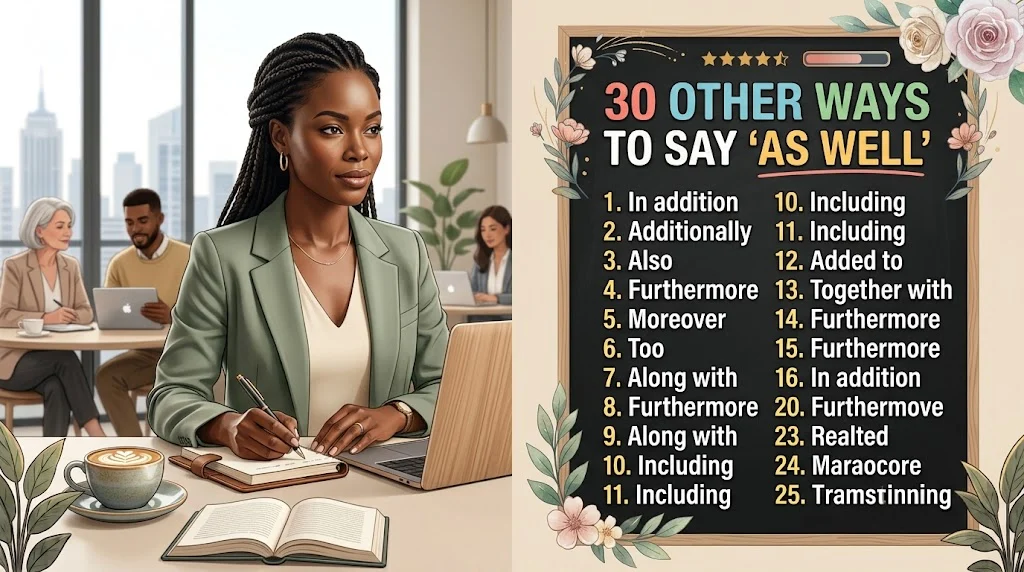
These 30 alternatives will help you sound more fluent, confident, and natural in different situations. Use them according to tone, context, and audience to express excitement in English, add information gracefully, and communicate with precision.
Formal Alternatives
1. Phrase: In Addition
Meaning: Used to introduce an extra piece of information.
Explanation: A formal and widely accepted phrase for adding points.
Example Sentence: “In addition to the main report, we have prepared a summary for the board.”
Best Use: Business writing
Worst Use: Casual texting
Tone: Professional, neutral
Context Variability: Formal reports, presentations, academic writing
2. Phrase: Additionally
Meaning: In addition; as an extra element.
Explanation: A smooth, professional transition word.
Example Sentence: “The project is on schedule. Additionally, we have secured extra funding.”
Best Use: Reports, emails
Worst Use: Quick replies
Tone: Formal, clear
Context Variability: Professional documents, speeches
3. Phrase: Furthermore
Meaning: In addition to what has just been stated.
Explanation: A strong formal connector for building arguments.
Example Sentence: “The data supports our hypothesis. Furthermore, the results are statistically significant.”
Best Use: Academic writing
Worst Use: Conversation
Tone: Formal, persuasive
Context Variability: Research papers, business proposals
4. Phrase: Moreover
Meaning: In addition to the previous point; more importantly.
Explanation: Emphasizes that the new point is significant.
Example Sentence: “The new policy saves time. Moreover, it reduces costs significantly.”
Best Use: Persuasive writing
Worst Use: Casual speech
Tone: Formal, emphatic
Context Variability: Essays, executive summaries
5. Phrase: In Conjunction With
Meaning: Together with; in combination with.
Explanation: A precise formal phrase for linked actions or items.
Example Sentence: “We are launching the campaign in conjunction with our international partners.”
Best Use: Official announcements
Worst Use: Everyday chat
Tone: Formal, collaborative
Context Variability: Corporate communications, legal documents
6. Phrase: In Addition To That
Meaning: Besides that point.
Explanation: A slightly less formal but still professional phrase.
Example Sentence: “In addition to that, we have revised the timeline.”
Best Use: Meetings, presentations
Worst Use: Text messages
Tone: Professional, clear
Context Variability: Business discussions, emails
7. Phrase: Over And Above
Meaning: More than what is expected or required.
Explanation: Emphasizes an extra contribution or benefit.
Example Sentence: “Over and above the standard features, this model includes a premium sound system.”
Best Use: Product descriptions
Worst Use: Casual talk
Tone: Formal, descriptive
Context Variability: Marketing, official documents
8. Phrase: Not To Mention
Meaning: Used to add an extra point that reinforces the argument.
Explanation: A formal way to highlight additional supporting information.
Example Sentence: “The candidate has excellent qualifications, not to mention years of relevant experience.”
Best Use: Recommendations
Worst Use: Short replies
Tone: Formal, persuasive
Context Variability: Reference letters, evaluations
“Alternatives to as well help you avoid repetition and sound more articulate.”
Professional Alternatives
9. Phrase: Along With
Meaning: Together with; in addition to.
Explanation: A versatile phrase for professional and neutral contexts.
Example Sentence: “Please submit the report along with the supporting data.”
Best Use: Instructions
Worst Use: Emotional statements
Tone: Professional, neutral
Context Variability: Work emails, project briefs
10. Phrase: Together With
Meaning: In combination with; accompanied by.
Explanation: A slightly more formal version of along with.
Example Sentence: “The CEO, together with the board members, approved the strategy.”
Best Use: Official communications
Worst Use: Daily banter
Tone: Formal, structured
Context Variability: Corporate reports, announcements
11. Phrase: Likewise
Meaning: In the same way; also.
Explanation: Useful for drawing parallels or showing agreement.
Example Sentence: “Our team supports the initiative, and we likewise encourage others to join.”
Best Use: Professional agreement
Worst Use: Disagreements
Tone: Professional, agreeable
Context Variability: Meetings, collaborative writing
12. Phrase: Equally
Meaning: To the same degree; in the same way.
Explanation: Highlights balance or parallel importance.
Example Sentence: “The proposal is cost effective and equally beneficial for all departments.”
Best Use: Balanced arguments
Worst Use: Informal notes
Tone: Professional, measured
Context Variability: Proposals, evaluations
13. Phrase: Correspondingly
Meaning: In a way that matches or relates to something.
Explanation: A precise term for proportional or matched additions.
Example Sentence: “Sales increased, and profits rose correspondingly.”
Best Use: Data analysis
Worst Use: Everyday talk
Tone: Formal, analytical
Context Variability: Financial reports, research
14. Phrase: As Well As That
Meaning: In addition to that.
Explanation: A professional connector for adding related points.
Example Sentence: “The software is user friendly. As well as that, it offers advanced security features.”
Best Use: Product reviews
Worst Use: Quick chats
Tone: Professional, descriptive
Context Variability: Business presentations, websites
15. Phrase: Coupled With
Meaning: Combined with; together with.
Explanation: Emphasizes the combined effect of two elements.
Example Sentence: “Coupled with excellent customer service, our product guarantees satisfaction.”
Best Use: Marketing copy
Worst Use: Casual conversation
Tone: Professional, persuasive
Context Variability: Advertising, proposals
16. Phrase: In The Same Way
Meaning: Similarly; in a comparable manner.
Explanation: Draws a parallel between two ideas or actions.
Example Sentence: “We handled the first phase efficiently. In the same way, we will approach the second.”
Best Use: Process explanations
Worst Use: Emotional expressions
Tone: Professional, instructional
Context Variability: Training, manuals
Casual Alternatives
17. Phrase: Also
Meaning: In addition; too.
Explanation: The most common one word alternative to as well.
Example Sentence: “I also think we should reconsider the timeline.”
Best Use: Any casual context
Worst Use: Overuse in formal writing
Tone: Neutral, versatile
Context Variability: Spoken and written English
18. Phrase: Too
Meaning: In addition; also.
Explanation: Often placed at the end of a sentence; very natural in speech.
Example Sentence: “I would like to come too.”
Best Use: Conversations
Worst Use: Formal documents
Tone: Friendly, casual
Context Variability: Everyday interactions
19. Phrase: Plus
Meaning: In addition; and also.
Explanation: A short, conversational connector.
Example Sentence: “The hotel has a pool, plus free breakfast every morning.”
Best Use: Informal descriptions
Worst Use: Professional reports
Tone: Relaxed, positive
Context Variability: Travel reviews, blogs
20. Phrase: On Top Of That
Meaning: In addition to everything else.
Explanation: Emphasizes an extra element, often unexpected.
Example Sentence: “On top of that, they offered us a discount.”
Best Use: Storytelling
Worst Use: Formal writing
Tone: Enthusiastic, casual
Context Variability: Narratives, conversations
21. Phrase: What Is More
Meaning: Moreover; in addition.
Explanation: Used to introduce an even stronger point.
Example Sentence: “The apartment is spacious. What is more, it has a sea view.”
Best Use: Persuasive talk
Worst Use: Formal essays (use furthermore instead)
Tone: Emphatic, casual
Context Variability: Opinions, recommendations
22. Phrase: Besides
Meaning: In addition; apart from.
Explanation: Often adds an extra reason or point.
Example Sentence: “Besides the main course, we ordered dessert.”
Best Use: Casual additions
Worst Use: Formal legal writing
Tone: Neutral, conversational
Context Variability: Daily conversations
23. Phrase: And
Meaning: Also; in addition.
Explanation: The simplest connector in English.
Example Sentence: “We need milk, eggs, and bread.”
Best Use: Lists
Worst Use: Complex sentences
Tone: Neutral, basic
Context Variability: All contexts
“Varying your vocabulary is the secret to sounding like a native speaker.”
Informal Expressions
24. Phrase: To Boot
Meaning: In addition; as an extra.
Explanation: An old fashioned but charming informal phrase.
Example Sentence: “She is beautiful, smart, and wealthy to boot.”
Best Use: Playful descriptions
Worst Use: Professional settings
Tone: Playful, informal
Context Variability: Creative writing, stories
25. Phrase: Into The Bargain
Meaning: In addition; as an extra benefit.
Explanation: Emphasizes an unexpected bonus.
Example Sentence: “We got a free upgrade into the bargain.”
Best Use: Casual storytelling
Worst Use: Business reports
Tone: Informal, cheerful
Context Variability: Travel, shopping experiences
26. Phrase: For Good Measure
Meaning: As an extra; in addition to what is needed.
Explanation: Suggests adding something extra for completeness.
Example Sentence: “Add a pinch of salt for good measure.”
Best Use: Cooking, casual advice
Worst Use: Formal writing
Tone: Informal, practical
Context Variability: Instructions, tips
27. Phrase: As An Extra
Meaning: In addition; as a bonus.
Explanation: A straightforward informal expression.
Example Sentence: “They threw in a free charger as an extra.”
Best Use: Shopping, deals
Worst Use: Academic texts
Tone: Casual, descriptive
Context Variability: Consumer contexts
28. Phrase: Withal
Meaning: In addition; nevertheless.
Explanation: An archaic but stylish word for literary contexts.
Example Sentence: “It was a difficult journey, and withal, a rewarding one.”
Best Use: Literary writing
Worst Use: Modern conversation
Tone: Archaic, poetic
Context Variability: Creative writing
29. Phrase: Likewise So
Meaning: In the same way; also.
Explanation: A slightly emphatic version of likewise.
Example Sentence: “She loves hiking, and likewise so does her brother.”
Best Use: Informal agreement
Worst Use: Formal documents
Tone: Friendly, agreeable
Context Variability: Conversations
30. Phrase: And All
Meaning: Including everything; in addition.
Explanation: A casual phrase for grouping things together.
Example Sentence: “We packed food, clothes, and all for the trip.”
Best Use: Informal lists
Worst Use: Professional writing
Tone: Relaxed, colloquial
Context Variability: Casual speech
“Professional communication is about choosing the right word for the right audience.”
Mini Quiz / Self Check
1. Which alternative is most appropriate for an academic paper?
a) Plus
b) Furthermore
c) To boot
Answer: b) Furthermore
2. You are writing a casual email to a colleague. Which phrase sounds most natural?
a) In conjunction with
b) On top of that
c) Withal
Answer: b) On top of that
3. Which of these is NOT a synonym for as well?
a) Likewise
b) Additionally
c) However
Answer: c) However
4. In a business presentation, which phrase is most professional?
a) As well
b) In addition
c) Too
Answer: b) In addition
Comparison Table: Top 10 Alternatives
| Phrase | Tone | Best Use |
| In addition | Formal | Reports, business writing |
| Additionally | Formal | Professional documents |
| Furthermore | Formal | Academic essays |
| Moreover | Formal | Persuasive arguments |
| Along with | Professional | Instructions, emails |
| Likewise | Professional | Agreement, parallels |
| Also | Neutral | Everyday use |
| Too | Casual | Conversations |
| Plus | Casual | Informal lists |
| On top of that | Informal | Storytelling |
FAQs
1. Is “as well” grammatically correct?
Yes, as well is grammatically correct and commonly used to mean “in addition” or “also”.
2. What is the difference between “as well” and “as well as”?
As well means “also” and appears at the end of a clause. As well as is a conjunction meaning “in addition to” and connects two elements.
3. Can I start a sentence with “as well”?
No. As well typically appears at the end of a clause. Use in addition or furthermore to start sentences.
4. Is “as well” formal or informal?
As well is neutral but leans slightly informal. For formal writing, prefer in addition, additionally, or furthermore.
5. What is a professional alternative to “as well”?
In addition, along with, and likewise are strong professional alternatives.
Conclusion
Learning alternatives as well is one of the simplest ways to elevate your English from basic to brilliant. Each alternative carries its own tone, nuance, and best use scenario. The key to mastery is not memorizing every word but understanding when and why to use each one.
Start by replacing as well with one new alternative each day. Notice how your writing becomes more precise and your speech more engaging. With practice, you will naturally choose the right word for every context whether you are sending a quick text, writing a business email, or delivering a formal presentation.

Sally Rooney is an American writer who contributes to QuickResponsess.com, creating clear and practical content for English learners. Her articles help readers build confidence in using words and expressions accurately in everyday and professional communication.