Quick Answer
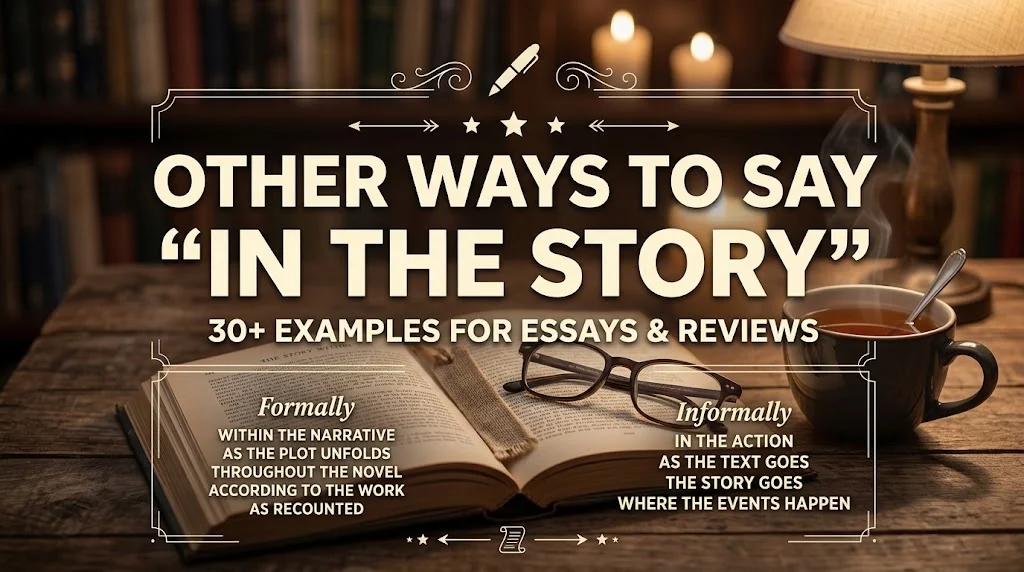
“In the story” is a phrase used to refer to events, characters, or details within a narrative. For more variety and precision, try alternatives like “in the narrative,” “within the plot,” “in this tale,” “throughout the story,” or “in the account.”
“In the story” is one of the most common phrases in English when discussing books, films, news reports, and even real life events. It appears in classrooms, book clubs, film reviews, business case studies, and everyday conversation. It signals that you are referring to events inside a narrative rather than outside it. Because it is so useful, many learners use it constantly, which makes their descriptions sound repetitive.
Learning the alternatives to in the story gives you the ability to be more precise. You can distinguish between plot, narrative, account, and version. You can also express excitement in English when describing a twist or a turning point.
This guide presents 30 practical alternatives with meanings, examples, and clear notes on tone. Whether you are writing a literary essay, a film review, or a business report, these options will help you sound fluent, confident, and precise.
Pull Quote: “Precision in storytelling is not decoration. It is the difference between clarity and confusion.”
Quick Categories
Formal alternatives to “In the story”
- In the narrative
- Within the text
- In the account
- In the chronicle
Pro Tip: Formal alternatives suit academic essays, literary analysis, and official reports.
Casual alternatives
- In the plot
- In the tale
- In the book
- In the film
Pro Tip: Casual options work in book clubs, film discussions, and relaxed conversation.
Professional alternatives
- In the case study
- In the report
- In the record
- In the documentation
Pro Tip: Professional alternatives should match the type of document or case you are discussing.
Informal expressions
- In the storyline
- In the version
- In the whole thing
- In that part
Pro Tip: Informal expressions belong in spoken English and casual reviews.
Pull Quote: “The right tone makes your English sound professional and confident.”
Common Mistakes
- Using “in the story” for real events.
Example: “In the story, the company lost money” when describing a real financial report. - Confusing story with plot.
Example: “In the story” when you mean the structure of events specifically, which is the plot. - Using it without naming the story.
Example: “In the story, the hero dies” without saying which story. - Mixing narrative and reality.
Example: “In the story, I was late for work” when talking about your own morning. - Overusing it in a single paragraph.
Example: “In the story, in the story, in the story.” Repetition weakens writing.
What Does “In the Story” Mean?
Definition
It is a prepositional phrase used to refer to events, characters, settings, or details located within a narrative, whether fictional or factual.
Grammar Explanation
“In” is a preposition of location, “the” is a definite article, and “story” is a noun. Together they form an adverbial phrase that situates information inside a narrative frame.
Example Sentence
“In the story, the main character learns the value of patience.”
When to Use “In the Story”
Common Contexts
- Literature: Discussing novels, short stories, and poems.
- Film and television: Reviewing or summarising plots.
- News: Describing reported events.
- Business: Referring to case studies and reports.
- Everyday conversation: Sharing anecdotes and experiences.
Spoken vs Written
- Spoken: Common in casual discussion and storytelling.
- Written: Very common in essays, reviews, and reports.
Formal vs Informal
- Formal: Acceptable in most contexts but often replaced by more precise terms.
- Informal: The default choice in everyday speech.
Is It Professional or Polite to Say “In the Story”?
Politeness vs Professionalism
The phrase is polite and neutral, and it is appropriate in most settings. However, in professional and academic writing, more precise alternatives such as “in the narrative” or “in the case study” often read better.
Business-Style Example
“In the case study, the company recovered within eighteen months.”
Polite? Yes
Professional? Sometimes, but more specific wording is usually stronger
Pull Quote: “Specific words build credibility. Vague references build distance.”
Pros and Cons of Using “In the Story”
Pros
- Simple and natural: Universally understood.
- Friendly tone: Neutral and accessible.
- Common usage: Recognised in every English speaking country.
- Easy to understand: Requires no specialist vocabulary.
Cons
- Too informal for work: Can sound vague in professional writing.
- Overused: Loses impact through repetition.
- Limited emotional range: Cannot express mood or structure.
- Not suitable for formal writing: Acceptable, but precise alternatives read better.
Other Ways to Say “In the Story” (With Examples)
These alternatives will help you sound more fluent, confident, and natural in different situations. Use them according to tone, context, and audience to express excitement, admiration, or approval.
1. In the narrative
Meaning: Within the structured account of events.
Explanation: Formal and academic.
Example Sentence: “In the narrative, the author shifts between past and present.”
Best Use: Literary analysis
Worst Use: Casual chats
Tone: Formal, academic, precise
Context Variability: Professional and written
2. Within the plot
Meaning: Inside the sequence of events.
Explanation: Focuses on structure rather than theme.
Example Sentence: “Within the plot, the betrayal comes as a complete surprise.”
Best Use: Film, literature
Worst Use: Business reports
Tone: Analytical, structured, neutral
Context Variability: Professional and written
3. In this tale
Meaning: Within this particular story.
Explanation: Slightly literary and warm.
Example Sentence: “In this tale, kindness is rewarded in unexpected ways.”
Best Use: Storytelling
Worst Use: Formal reports
Tone: Literary, warm, narrative
Context Variability: Creative and written
4. In the account
Meaning: Within a reported version of events.
Explanation: Formal and factual.
Example Sentence: “In the account, the witness describes three separate incidents.”
Best Use: News, reports
Worst Use: Fiction reviews
Tone: Formal, factual, neutral
Context Variability: Professional and written
5. In the chronicle
Meaning: Within a recorded history of events.
Explanation: Formal and historical.
Example Sentence: “In the chronicle, the king is portrayed as a reluctant ruler.”
Best Use: Historical writing
Worst Use: Casual chats
Tone: Formal, historical, serious
Context Variability: Professional and written
6. Throughout the story
Meaning: At many points across the narrative.
Explanation: Emphasises continuity.
Example Sentence: “Throughout the story, the theme of loss is present.”
Best Use: Essays, reviews
Worst Use: Casual chats
Tone: Formal, analytical, steady
Context Variability: Professional and written
7. In the storyline
Meaning: Within the main sequence of events.
Explanation: Modern and accessible.
Example Sentence: “In the storyline, the hero returns to his hometown.”
Best Use: Film, TV
Worst Use: Legal writing
Tone: Modern, casual, clear
Context Variability: Casual and spoken
8. In the book
Meaning: Within the written work.
Explanation: Specific and clear.
Example Sentence: “In the book, the ending is far darker than the film.”
Best Use: Book clubs
Worst Use: Business writing
Tone: Neutral, specific, casual
Context Variability: Casual and spoken
9. In the film
Meaning: Within the movie version.
Explanation: Specific to cinema.
Example Sentence: “In the film, the setting moves from Paris to Tokyo.”
Best Use: Film reviews
Worst Use: Academic papers
Tone: Neutral, specific, casual
Context Variability: Casual and written
10. In the case study
Meaning: Within a detailed business or academic example.
Explanation: Professional and specific.
Example Sentence: “In the case study, the firm restructured its supply chain.”
Best Use: Business, academia
Worst Use: Fiction reviews
Tone: Professional, formal, precise
Context Variability: Professional and written
11. In the report
Meaning: Within an official document.
Explanation: Formal and factual.
Example Sentence: “In the report, the auditors highlight three key risks.”
Best Use: Business, government
Worst Use: Casual chats
Tone: Formal, factual, official
Context Variability: Professional and written
12. In the record
Meaning: Within documented evidence.
Explanation: Formal and legal.
**Example Sentence: “In the record, there is no mention of the payment.”
Best Use: Legal, official
Worst Use: Casual conversations
Tone: Formal, legal, precise
Context Variability: Professional and written
13. In the version
Meaning: Within one particular retelling.
Explanation: Useful when comparing adaptations.
Example Sentence: “In the version I read, the ending is completely different.”
Best Use: Comparisons
Worst Use: Formal reports
Tone: Neutral, comparative, casual
Context Variability: Casual and spoken
14. In the retelling
Meaning: Within a new version of an old story.
Explanation: Literary and comparative.
Example Sentence: “In the retelling, the villain becomes the hero.”
Best Use: Literary analysis
Worst Use: Business writing
Tone: Literary, analytical, creative
Context Variability: Professional and written
15. In the adaptation
Meaning: Within a version adapted from another source.
Explanation: Common in film and theatre.
Example Sentence: “In the adaptation, several characters are removed entirely.”
Best Use: Film, theatre
Worst Use: Casual chats
Tone: Analytical, cultural, neutral
Context Variability: Professional and written
16. In the sequence
Meaning: Within a specific ordered set of events.
Explanation: Technical and structural.
Example Sentence: “In the opening sequence, we see the city at dawn.”
Best Use: Film analysis
Worst Use: Casual chats
Tone: Technical, analytical, precise
Context Variability: Professional and written
17. In the anecdote
Meaning: Within a short personal story.
Explanation: Warm and conversational.
Example Sentence: “In the anecdote, he describes his first day at work.”
Best Use: Speeches, essays
Worst Use: Formal reports
Tone: Warm, personal, narrative
Context Variability: Professional and spoken
18. In the legend
Meaning: Within a traditional or mythical story.
Explanation: Cultural and historical.
Example Sentence: “In the legend, the mountain was formed by a giant’s tears.”
Best Use: Cultural writing
Worst Use: Business contexts
Tone: Mythical, cultural, formal
Context Variability: Professional and written
19. In the fable
Meaning: Within a short moral story.
Explanation: Educational and symbolic.
Example Sentence: “In the fable, the tortoise teaches us about patience.”
Best Use: Education
Worst Use: Formal reports
Tone: Educational, symbolic, warm
Context Variability: Professional and written
20. In the memoir
Meaning: Within a personal written account.
Explanation: Reflective and personal.
Example Sentence: “In the memoir, she recalls her childhood in Cairo.”
Best Use: Literary, personal
Worst Use: Business writing
Tone: Reflective, personal, literary
Context Variability: Professional and written
21. In the testimonial
Meaning: Within a personal account of an event.
Explanation: Formal and often legal.
Example Sentence: “In the testimonial, the witness describes the scene clearly.”
Best Use: Legal, journalistic
Worst Use: Fiction
Tone: Formal, factual, serious
Context Variability: Professional and written
22. In the narrative arc
Meaning: Within the overall shape of the story.
Explanation: Academic and structural.
**Example Sentence: “In the narrative arc, the climax arrives unusually early.”
Best Use: Literary analysis
Worst Use: Casual chats
Tone: Academic, analytical, precise
Context Variability: Professional and written
23. In the backstory
Meaning: Within the events preceding the main story.
Explanation: Informative and explanatory.
Example Sentence: “In the backstory, we learn why the brothers fell out.”
Best Use: Film, literature
Worst Use: Formal reports
Tone: Explanatory, narrative, informative
Context Variability: Casual and written
24. In the subplot
Meaning: Within a secondary storyline.
Explanation: Structural and analytical.
Example Sentence: “In the subplot, the neighbour hides a secret.”
Best Use: Literary analysis
Worst Use: Casual chats
Tone: Analytical, structural, neutral
Context Variability: Professional and written
25. In the scene
Meaning: Within a specific moment of a narrative.
Explanation: Specific and visual.
Example Sentence: “In the final scene, the two rivals finally reconcile.”
Best Use: Film, theatre
Worst Use: Business writing
Tone: Visual, specific, dramatic
Context Variability: Casual and written
26. In the chapter
Meaning: Within a section of a written work.
Explanation: Specific and practical.
Example Sentence: “In the third chapter, the tone shifts dramatically.”
Best Use: Book discussion
Worst Use: Film reviews
Tone: Neutral, specific, academic
Context Variability: Professional and written
27. In the opening
Meaning: Within the beginning of a story.
Explanation: Structural and analytical.
Example Sentence: “In the opening, the author establishes a sense of unease.”
Best Use: Literary analysis
Worst Use: Business reports
Tone: Analytical, formal, precise
Context Variability: Professional and written
28. In the finale
Meaning: Within the ending of a story.
Explanation: Dramatic and conclusive.
**Example Sentence: “In the finale, every thread is tied together neatly.”
Best Use: Film, TV
Worst Use: Business writing
Tone: Dramatic, conclusive, analytical
Context Variability: Casual and written
29. In that part
Meaning: Within a specific section.
Explanation: Very casual and vague.
Example Sentence: “In that part, I completely lost track of who was who.”
Best Use: Casual chats
Worst Use: Formal writing
Tone: Casual, vague, informal
Context Variability: Casual and spoken
30. In the whole thing
Meaning: Across the entire story.
Explanation: Very informal and general.
**Example Sentence: “In the whole thing, there is not one likeable character.”
Best Use: Casual reviews
Worst Use: Formal reports
Tone: Informal, general, conversational
Context Variability: Casual and spoken
Pull Quote: “Professional reaction phrases and precise narrative terms both show the same thing: you read carefully and thought clearly.”
Mini Quiz / Self-Check
- Scenario: You are writing a literary essay about a novel. Which fits best?
- A) In the whole thing.
- B) In the narrative.
- C) In that part.
- Scenario: You are discussing a film with friends. Which is most natural?
- A) In the film, the ending surprised everyone.
- B) In the chronicle, the ending surprised everyone.
- C) In the case study, the ending surprised everyone.
- Scenario: You are writing a business report about a company’s recovery. Which is most appropriate?
- A) In the case study, the firm recovered within a year.
- B) In the fable, the firm recovered within a year.
- C) In the backstory, the firm recovered within a year.
- Scenario: Which phrase is generally too informal for an academic essay?
- A) In the narrative.
- B) In the whole thing.
- C) In the account.
Comparison Table: Top Alternatives
| Phrase | Tone | Best Use |
| In the narrative | Formal, academic | Literary analysis |
| Within the plot | Analytical, structured | Film, literature |
| In the account | Formal, factual | News, reports |
| Throughout the story | Formal, analytical | Essays, reviews |
| In the case study | Professional, precise | Business, academia |
| In the report | Formal, official | Business, government |
| In the version | Neutral, comparative | Comparisons |
| In the memoir | Reflective, personal | Literary, personal |
| In the scene | Visual, specific | Film, theatre |
| In the finale | Dramatic, conclusive | Film, TV |
FAQs
1. What is a formal alternative to “in the story”?
“In the narrative,” “in the account,” and “throughout the story” are strong formal alternatives suitable for academic essays and literary analysis.
2. What is the difference between “story” and “plot”?
A story is the full sequence of events including background, while the plot is the structured arrangement of those events as presented to the reader.
3. How do I refer to a specific part of a story?
Use precise phrases such as “in the opening,” “in the final scene,” or “in the third chapter” to locate your reference clearly.
4. What can I say instead of “in the story” in casual conversation?
“In the book,” “in the film,” and “in that part” are natural and informal alternatives for everyday speech.
5. Is “in the story” suitable for business writing?
It is acceptable in case studies but vague in formal reports. “In the case study” or “in the report” reads as more professional.
Conclusion
Learning other ways to say in the story gives you the precision to discuss narratives with clarity, whether you are analysing a novel, reviewing a film, or writing a business case study. The right phrase tells your reader exactly where you are pointing inside the text. These alternatives to in the story help you move beyond one overused phrase and into richer, more accurate expression.
Practise by choosing one new alternative each time you discuss a book, film, or report. Pay close attention to tone and context, because the right word depends on the genre and the audience. With steady practice, these informal expressions in English and their formal counterparts will become part of your everyday fluency.

Sally Rooney is an American writer who contributes to QuickResponsess.com, creating clear and practical content for English learners. Her articles help readers build confidence in using words and expressions accurately in everyday and professional communication.