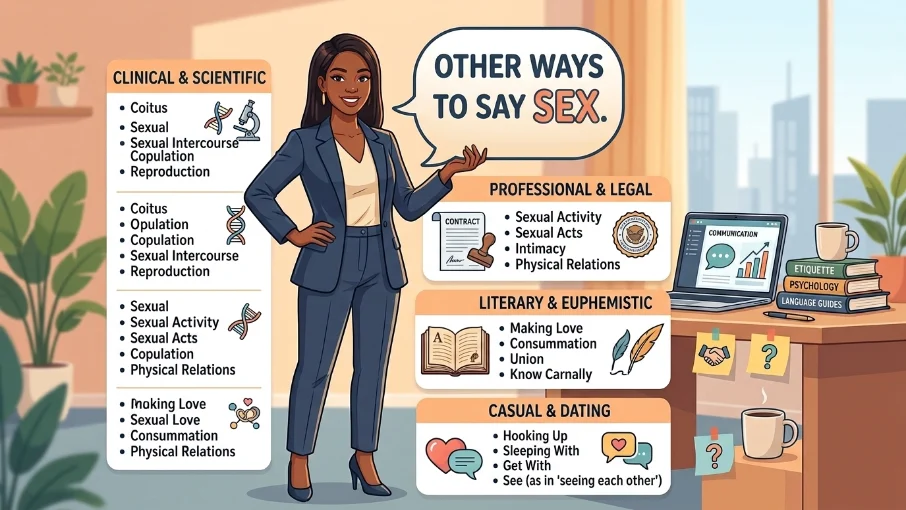
Quick Answer : Looking for other ways to say sex? Here are the top 5 alternatives: have intercourse, make love, sleep with someone, get intimate, and hook up. Choose based on your audience and context.
The word “sex” is direct, but it’s not always the right choice. In professional settings, formal writing, or even casual conversation, you might want alternatives that better match the tone and context. Understanding different expressions helps you navigate social situations with confidence and clarity.
Whether you are an English learner or a professional refining your communication skills, knowing alternatives to sex allows you to express intimacy in English appropriately. The right word can make you sound more polished, more respectful, or simply more natural in everyday conversation.
Quick Categories
Formal Alternatives to “Sex”
- Have sexual intercourse
- Engage in coitus
- Copulate
- Have carnal knowledge
Casual Alternatives
- Hook up
- Get lucky
- Get it on
- Do it
Professional Alternatives
- Have intimate relations
- Be physically intimate
- Have a sexual relationship
- Engage in sexual activity
Informal Expressions
- Sleep together
- Get busy
- Go all the way
- Fool around
Pro Tip: When in doubt, choose neutral terms like “have sex” or “be intimate.” These work in most situations without causing offense.
Common Mistakes
Using the wrong term can make you sound awkward or inappropriate. Here are five common errors:
- Using slang in formal contexts
Incorrect: “The report discusses how employees hook up after work events.”
Correct: “The report discusses workplace relationships among employees.” - Misusing “make love” for casual encounters
Incorrect: “We made love after our first date.” (sounds too intimate for a casual date)
Correct: “We slept together after our first date.” - Using “intercourse” in everyday conversation
Incorrect: “Did they have intercourse last night?” (too clinical)
Correct: “Did they sleep together last night?” - Confusing “hook up” with “hang out”
Incorrect: “We’re just hooking up as friends.” (implies sexual activity)
Correct: “We’re just hanging out as friends.” - Using “fornicate” in modern speech
Incorrect: “They fornicated at the party.” (sounds archaic or judgmental)
Correct: “They hooked up at the party.”
What Does “Sex” Mean?
Sex refers to the biological and physiological characteristics that define humans as female or male. It is also the common term for engaging in intimate physical activity with a partner.
Example Sentence:
They decided to have sex after months of dating.
When to Use “Sex”
Common Contexts:
- Medical and health discussions
- Scientific or educational content
- Casual conversation among close friends
- Formal writing when directness is acceptable
Spoken vs Written: Acceptable in both but tone varies. More direct in speech, often replaced with formal alternatives in writing.
Formal vs Informal: Neutral but leans informal in most professional settings.
Is It Professional or Polite to Say “Sex”?
Polite? ✔️ Yes, in most contexts.
Professional? ❌ No, in most workplace or formal settings.
Example:
Instead of: “The training covers sex education.”
Use: “The training covers sexual health education.”
“Tone awareness is the key to professional English. When in doubt, choose neutral alternatives.”
Pros and Cons of Using “Sex”
Pros:
- Simple and universally understood
- Natural and direct
- Common usage across all English levels
- Easy for learners to remember
Cons:
- Too informal for workplace communication
- Overused and lacking nuance
- Limited emotional range
- Not suitable for formal writing or presentations
Other Ways to Say “Sex” (With Examples)
These alternatives will help you sound more fluent, confident, and natural in different situations. Use them according to tone, context, and audience to communicate effectively.
1. Phrase: Have sexual intercourse
Meaning: The formal medical term for penetrative sex.
Explanation: Used in clinical, legal, or educational contexts.
Example Sentence: The study surveyed teenagers about their experiences with sexual intercourse.
Best Use: Medical contexts
Worst Use: Casual conversation
Tone: Clinical, formal
Context Variability: Professional / Medical / Educational
2. Phrase: Make love
Meaning: To have sex with emotional intimacy.
Explanation: Implies a romantic connection between partners.
Example Sentence: They made love for the first time on their wedding night.
Best Use: Romantic relationships
Worst Use: Casual encounters
Tone: Intimate, romantic
Context Variability: Romantic / Spoken
3. Phrase: Sleep with someone
Meaning: To have sex, often implying a relationship.
Explanation: A polite, indirect way to refer to sexual activity.
Example Sentence: She found out he had slept with her best friend.
Best Use: Polite conversation
Worst Use: Professional reports
Tone: Neutral, indirect
Context Variability: Casual / Spoken
4. Phrase: Hook up
Meaning: To have casual sex or make out.
Explanation: Very common among younger speakers; often implies no emotional commitment.
Example Sentence: They hooked up at the party last weekend.
Best Use: Casual settings
Worst Use: Formal writing
Tone: Informal, modern
Context Variability: Casual / Spoken
5. Phrase: Get intimate
Meaning: To engage in close physical or sexual activity.
Explanation: A polite and respectful way to refer to sex.
Example Sentence: They decided to get intimate after several months of dating.
Best Use: Polite conversation
Worst Use: Medical contexts
Tone: Respectful, gentle
Context Variability: Casual / Spoken
6. Phrase: Have relations
Meaning: An old fashioned term for sexual activity.
Explanation: Commonly used in historical or legal contexts.
Example Sentence: The scandal involved allegations that he had relations with multiple women.
Best Use: Historical contexts
Worst Use: Modern conversation
Tone: Old fashioned, formal
Context Variability: Formal / Written
7. Phrase: Get lucky
Meaning: To have sex, usually unexpectedly.
Explanation: Popularized by the Daft Punk song, implies a chance encounter.
Example Sentence: He was hoping to get lucky at the club.
Best Use: Casual conversation
Worst Use: Professional settings
Tone: Playful, informal
Context Variability: Casual / Spoken
8. Phrase: Do it
Meaning: A childish or euphemistic way to say sex.
Explanation: Often used by teenagers or as a lighthearted reference.
Example Sentence: They finally did it after three months of dating.
Best Use: Casual conversation
Worst Use: Formal writing
Tone: Childish, indirect
Context Variability: Casual / Spoken
9. Phrase: Get it on
Meaning: To have sex or engage in sexual activity.
Explanation: Made popular by the Marvin Gaye song; can sound dated.
Example Sentence: They were getting it on in the back of the car.
Best Use: Casual settings
Worst Use: Professional contexts
Tone: Energetic, informal
Context Variability: Casual / Spoken
10. Phrase: Be intimate
Meaning: To share a close physical or emotional connection.
Explanation: Often used to refer to sex in a respectful, emotional way.
Example Sentence: They had been intimate on several occasions.
Best Use: Polite conversation
Worst Use: Casual settings
Tone: Respectful, emotional
Context Variability: Formal / Spoken
11. Phrase: Have an affair
Meaning: A sexual relationship outside of marriage.
Explanation: Implies secrecy and emotional involvement.
Example Sentence: She discovered her husband was having an affair with his secretary.
Best Use: Discussion of infidelity
Worst Use: Casual conversation
Tone: Serious, dramatic
Context Variability: Formal / Spoken
12. Phrase: Copulate
Meaning: The biological term for sexual reproduction.
Explanation: Used in scientific or zoological contexts.
Example Sentence: The documentary showed how animals copulate to reproduce.
Best Use: Scientific contexts
Worst Use: Everyday conversation
Tone: Scientific, clinical
Context Variability: Professional / Written
13. Phrase: Fornicate
Meaning: To have sex outside of marriage.
Explanation: An archaic term with moral or religious connotations.
Example Sentence: The sermon warned against those who fornicate before marriage.
Best Use: Historical or religious contexts
Worst Use: Modern conversation
Tone: Archaic, moralistic
Context Variability: Formal / Written
14. Phrase: Engage in sexual activity
Meaning: The formal, professional term for any sexual act.
Explanation: Used in legal, medical, and educational materials.
Example Sentence: Participants were asked about their engagement in sexual activity.
Best Use: Professional contexts
Worst Use: Casual conversation
Tone: Clinical, formal
Context Variability: Professional / Written
15. Phrase: Sleep together
Meaning: To have sex (similar to “sleep with someone”).
Explanation: A common, neutral expression in everyday English.
Example Sentence: They started sleeping together after a few dates.
Best Use: Everyday conversation
Worst Use: Professional writing
Tone: Neutral, indirect
Context Variability: Casual / Spoken
16. Phrase: Go all the way
Meaning: To have full sexual intercourse.
Explanation: A dated euphemism, often used to avoid saying “sex.”
Example Sentence: They kissed but didn’t go all the way.
Best Use: Casual conversation
Worst Use: Formal writing
Tone: Dated, indirect
Context Variability: Casual / Spoken
17. Phrase: Get busy
Meaning: A playful, informal term for sex.
Explanation: Popularized by the 1990s song “Let’s Get Busy.”
Example Sentence: They were getting busy in the bedroom.
Best Use: Casual, playful conversation
Worst Use: Professional contexts
Tone: Playful, informal
Context Variability: Casual / Spoken
18. Phrase: Have carnal knowledge
Meaning: The legal term for sexual intercourse.
Explanation: Used in legal documents and historical texts.
Example Sentence: The defendant admitted to having carnal knowledge of the victim.
Best Use: Legal contexts
Worst Use: Everyday conversation
Tone: Legal, formal
Context Variability: Professional / Written
19. Phrase: Mate
Meaning: To have sex (usually used for animals).
Explanation: Rarely used for humans; common in biology.
Example Sentence: The lions mate during the rainy season.
Best Use: Scientific contexts
Worst Use: Human relationships
Tone: Scientific, objective
Context Variability: Professional / Written
20. Phrase: Get some
Meaning: To have sex (slang).
Explanation: Very informal; often implies a casual or opportunistic encounter.
Example Sentence: He was hoping to get some at the party.
Best Use: Casual conversation
Worst Use: Any formal setting
Tone: Slang, casual
Context Variability: Casual / Spoken
21. Phrase: Take to bed
Meaning: To have sex with someone.
Explanation: A slightly formal but intimate way to refer to sex.
Example Sentence: He took her to bed on their second date.
Best Use: Spoken conversation
Worst Use: Professional writing
Tone: Intimate, slightly formal
Context Variability: Casual / Spoken
22. Phrase: Ravish
Meaning: To have passionate, intense sex.
Explanation: Suggests overwhelming desire or forcefulness.
Example Sentence: She fantasized about being ravished by her celebrity crush.
Best Use: Romantic contexts
Worst Use: Casual conversation
Tone: Intense, romantic
Context Variability: Casual / Spoken
23. Phrase: Get down and dirty
Meaning: To have passionate, uninhibited sex.
Explanation: Very informal; implies a lack of restraint.
Example Sentence: They got down and dirty at the hotel.
Best Use: Casual, playful conversation
Worst Use: Formal settings
Tone: Playful, intense
Context Variability: Casual / Spoken
24. Phrase: Have a sexual relationship
Meaning: The professional term for a relationship involving sex.
Explanation: Used in psychology, counseling, and workplace contexts.
Example Sentence: The therapist asked if they were having a sexual relationship.
Best Use: Professional contexts
Worst Use: Casual conversation
Tone: Professional, neutral
Context Variability: Professional / Written
25. Phrase: Boink
Meaning: Slang for sex (often used humorously).
Explanation: Less crude than some alternatives; common in comedy.
Example Sentence: They were boinking like rabbits.
Best Use: Humorous contexts
Worst Use: Any formal setting
Tone: Humorous, informal
Context Variability: Casual / Spoken
26. Phrase: Boning
Meaning: Slang for sex.
Explanation: Derived from “boner” (erection); casual and direct.
Example Sentence: He bragged about boning his new girlfriend.
Best Use: Casual conversation
Worst Use: Professional contexts
Tone: Slang, casual
Context Variability: Casual / Spoken
27. Phrase: Bumping uglies
Meaning: A humorous, vulgar term for sex.
Explanation: Playful but crude; best used among close friends.
Example Sentence: They spent the weekend bumping uglies.
Best Use: Humorous contexts
Worst Use: Any formal setting
Tone: Vulgar, playful
Context Variability: Casual / Spoken
28. Phrase: Knocking boots
Meaning: A playful slang term for sex.
Explanation: Suggests casual or fun sexual activity.
Example Sentence: They’ve been knocking boots for months.
Best Use: Casual conversation
Worst Use: Professional contexts
Tone: Playful, slang
Context Variability: Casual / Spoken
29. Phrase: A roll in the hay
Meaning: A casual, spontaneous sexual encounter.
Explanation: A lighthearted and old fashioned term.
Example Sentence: They had a quick roll in the hay at the barn.
Best Use: Playful, casual contexts
Worst Use: Formal settings
Tone: Lighthearted, dated
Context Variability: Casual / Spoken
30. Phrase: Shag
Meaning: British slang for sex.
Explanation: Commonly used in the UK; more casual than “have sex.”
Example Sentence: They shagged after the party.
Best Use: Casual conversation (UK)
Worst Use: Professional contexts
Tone: Slang, casual
Context Variability: Casual / Spoken
“The right term transforms your communication from awkward to appropriate. Choose wisely based on your audience.”
Mini Quiz / Self Check
1. Which term is most appropriate for a medical report?
A) Hook up
B) Have sexual intercourse
C) Get lucky
Answer: B) Have sexual intercourse
2. Which phrase best describes a casual encounter without emotional attachment?
A) Make love
B) Sleep together
C) Hook up
Answer: C) Hook up
3. Which phrase would you use to politely refer to sex in a professional setting?
A) Bumping uglies
B) Have a sexual relationship
C) Boning
Answer: B) Have a sexual relationship
4. Which term is most appropriate for a romantic, committed relationship?
A) Make love
B) Get some
C) Shag
Answer: A) Make love
Comparison Table: Top Alternatives
| Phrase | Tone | Best Use |
| Have sexual intercourse | Clinical, formal | Medical or legal contexts |
| Make love | Romantic, intimate | Committed relationships |
| Sleep with someone | Neutral, indirect | Polite conversation |
| Hook up | Informal, modern | Casual encounters |
| Get intimate | Respectful, gentle | Polite conversation |
| Have relations | Old fashioned, formal | Historical or legal contexts |
| Get lucky | Playful, informal | Casual conversation |
| Be intimate | Respectful, emotional | Discussion of emotional connection |
| Have an affair | Serious, dramatic | Discussion of infidelity |
| Copulate | Scientific, clinical | Zoological or biological contexts |
FAQs
1. What is the most professional way to say “sex”?
“Have sexual intercourse,” “engage in sexual activity,” or “have a sexual relationship” are the most professional terms. They are used in medical, legal, and workplace contexts.
2. What is a polite way to say “sex” in everyday conversation?
“Sleep with someone” or “be intimate” are polite and widely understood alternatives that don’t sound crude or overly clinical.
3. What is a casual way to say “sex” among friends?
“Hook up,” “get lucky,” or “get it on” are commonly used in casual conversations among friends to refer to sex.
4. Is “make love” appropriate for all situations?
No. “Make love” implies emotional intimacy and is best used for romantic relationships, not casual encounters.
5. What’s the difference between “sex” and “intercourse”?
“Sex” is broader and can refer to gender, biological traits, or sexual activity. “Intercourse” specifically refers to penetrative sex.
Conclusion
Learning alternatives to common words like “sex” gives you greater control over your communication. The term you choose shapes how others perceive you whether you sound professional, casual, romantic, or respectful. With 30 alternatives at your disposal, you can now match your language to any situation with confidence.
Practice using these alternatives in daily conversation. Pay attention to how native speakers choose their words in different contexts. Over time, selecting the right term will feel natural and you’ll sound more fluent and polished in English.

Stephen King is an American writer and language enthusiast who enjoys creating clear, practical content that helps readers communicate with confidence. His work at QuickResponsess.com focuses on making English easier to understand through simple explanations and everyday examples.