Quick Answer 🔥
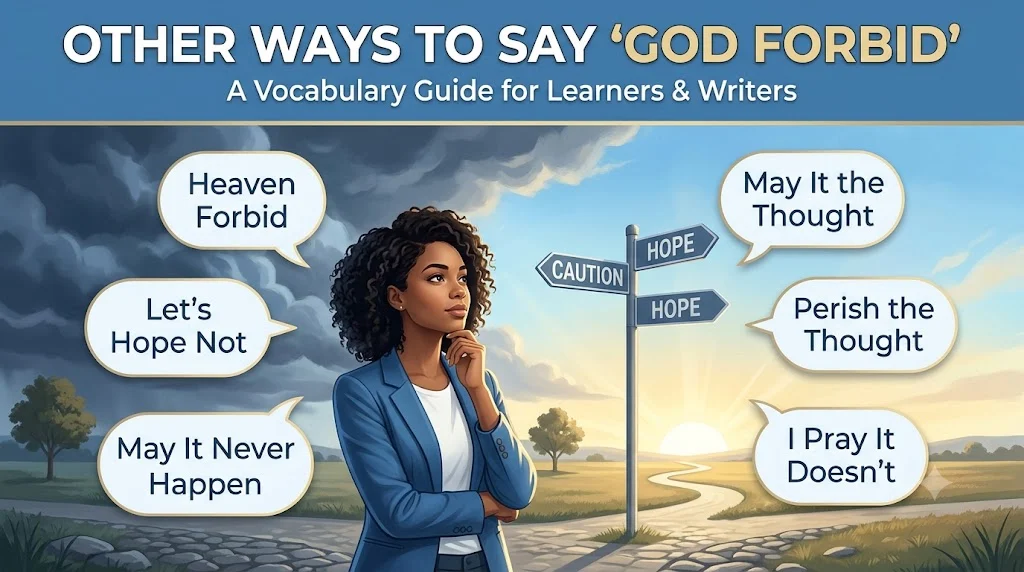
Other ways to say “God forbid” include Heaven forbid, Let’s hope not, I hope not, May it never happen, Perish the thought, Please no, Not if we can help it, That would be terrible, Hopefully not, and Let’s pray it doesn’t happen.
“God forbid” is an expression used to show strong hope, fear, or disapproval toward something bad that might happen . It reflects an emotional reaction, often tied to concern or disbelief, and is commonly used in serious and casual conversations .
While this phrase is widely understood, learning alternatives helps you express concern professionally, adapt to different audiences, and avoid potential religious connotations that some may find offensive . Whether you’re in a business meeting, writing an email, or having a casual conversation, having a range of alternatives to “God forbid” at your disposal makes you sound more fluent and culturally aware.
Quick Categories
Formal Alternatives to “God Forbid”
- In the unlikely event
- Should that situation arise
- We certainly hope not
- I’m sure it won’t come to that
Casual Alternatives
- Fingers crossed
- Knock on wood
- Let’s hope not
- Hopefully not
Professional Alternatives
- Hopefully that won’t happen
- I doubt it will happen
- Everything should be fine
- Let’s avoid that
Informal Expressions
- Don’t even think of it
- Let’s not go there
- I don’t even want to think about it
- That’s the last thing we need
💡 PRO TIP: Match the intensity of your alternative to the situation. Use formal phrases for business settings and casual ones for friendly conversations.
Common Mistakes Using “God forbid”
- Using it in formal writing – “The project will, God forbid, face delays.” ❌
Better: “In the unlikely event that the project faces delays…” - Using it when you mean “I hope” – “God forbid it rains tomorrow” when you simply mean “I hope it doesn’t rain”
- Using it sarcastically without clear context – Can confuse non native speakers
- Overusing it – Repeating it multiple times in one conversation sounds repetitive
- Using it in professional emails – “God forbid the client rejects this proposal” ❌
Better: “If the client rejects this proposal, we have a backup plan”
What Does “God forbid” Mean?
Definition: An expression used to say that you hope something will not happen . It can be used seriously, humorously, or sarcastically .
Grammar note: Often used with “that” + subject + verb (e.g., “God forbid that this happens”) or as an interjection (“God forbid!”) .
Example: “Maybe you’ll end up as a lawyer, like me.” “God forbid!”
When to Use “God forbid”
Common contexts:
- Expressing hope that a negative event won’t occur
- Showing concern about potential risks
- Reacting to an unpleasant suggestion
- Emphasizing how undesirable something would be
Spoken vs Written: Common in spoken English; less appropriate in formal writing
Formal vs Informal: Informal; considered too emotional or religious for professional settings
Is It Professional or Polite to Say “God forbid”?
Polite? ✅ Yes – in casual conversation with friends and family
Professional? ❌ No – not suitable for most professional contexts
“In formal writing, ‘God forbid’ is often replaced with neutral alternatives like ‘in the unlikely event’ to maintain professionalism.”
Business style example: Instead of “God forbid we miss this deadline,” say “In the unlikely event we miss this deadline, we should have a contingency plan in place.”
Pros and Cons of Using “God forbid”
Pros ✅
- Simple and natural to say
- Friendly and conversational tone
- Widely understood by native speakers
- Easy to understand in context
Cons ❌
- Too informal for workplace communication
- Can be overused and repetitive
- Limited emotional range
- Not suitable for formal writing
Other Ways to Say “God forbid” (With Examples)
These alternatives will help you sound more fluent, confident, and natural in different situations. Use them according to tone, context, and audience to express concern, hope, and professionalism in English.
1. Phrase: Heaven forbid
Meaning: A softer variation of “God forbid” without direct religious weight
Explanation: Keeps the emotional message while sounding slightly lighter and more neutral
Example Sentence: “Heaven forbid we miss the deadline.”
Best Use: Polite conversations
Worst Use: Highly formal documents
Tone: Concerned, gentle
Context Variability: Suitable for most spoken situations
2. Phrase: Let’s hope not
Meaning: Expresses shared optimism that something negative won’t occur
Explanation: Less dramatic and more conversational than the original phrase
Example Sentence: “Let’s hope not, but delays are possible.”
Best Use: Team discussions
Worst Use: Serious warnings
Tone: Calm, hopeful
Context Variability: Casual to semi formal
3. Phrase: Perish the thought
Meaning: Rejects an idea strongly, often used when something seems unacceptable
Explanation: An old fashioned phrase that “kills” or forbids bad ideas
Example Sentence: “Perish the thought of losing our values.”
Best Use: Expressing disbelief
Worst Use: Informal chats
Tone: Firm, dramatic
Context Variability: Can be used in writing and speech
4. Phrase: In the unlikely event
Meaning: Introduces a possible future event formally, indicating low probability
Explanation: Neutral, professional alternative common in policies and planning
Example Sentence: “In the unlikely event that the server crashes, we have backups ready.”
Best Use: Professional documents
Worst Use: Casual chat
Tone: Formal, analytical
Context Variability: Professional settings
5. Phrase: Hopefully that won’t happen
Meaning: Expresses hope something negative will not occur
Explanation: Neutral and clear alternative suitable for meetings and planning
Example Sentence: “We’ve added extra security, hopefully that won’t happen.”
Best Use: Meetings, planning
Worst Use: Legal documents
Tone: Neutral
Context Variability: Professional and everyday
6. Phrase: I doubt it will happen
Meaning: Shows skepticism about a negative possibility
Explanation: Calm and reassuring way to ease concerns
Example Sentence: “The server might slow down during launch, but I doubt it will happen.”
Best Use: Meetings, risk discussions
Worst Use: Risk analysis
Tone: Reassuring
Context Variability: Professional conversations
7. Phrase: Fingers crossed
Meaning: Shows hope for a positive outcome
Explanation: Light and optimistic idiomatic expression
Example Sentence: “The client should confirm today—fingers crossed.”
Best Use: Friendly conversations
Worst Use: Professional documents
Tone: Playful
Context Variability: Casual, social media
8. Phrase: Knock on wood
Meaning: Expresses hope that good luck continues
Explanation: Familiar cultural idiom often used after mentioning something positive
Example Sentence: “We haven’t had any bugs in the system—knock on wood.”
Best Use: Casual conversation
Worst Use: Business writing
Tone: Idiomatic
Context Variability: More common in North America
9. Phrase: Let’s avoid that
Meaning: Suggests prevention rather than fear
Explanation: Focuses on action instead of emotion, making it more constructive
Example Sentence: “Let’s avoid that situation altogether.”
Best Use: Professional settings
Worst Use: Emotional support moments
Tone: Practical, neutral
Context Variability: Professional and everyday
10. Phrase: Don’t even think of it
Meaning: Used to encourage stopping negative thoughts
Explanation: Works well when you want to remove negative thoughts from your mind
Example Sentence: “Don’t even think of it! Just focus on my voice, and we’ll be fine.”
Best Use: Encouraging others
Worst Use: Formal situations
Tone: Firm, supportive
Context Variability: Casual conversations
11. Phrase: It’s not worth thinking about
Meaning: Encourages stopping thought processes about negative things
Explanation: Helps redirect focus away from stressful thoughts
Example Sentence: “Oh, stop it! It’s not worth thinking about.”
Best Use: Reassuring others
Worst Use: Professional settings
Tone: Comforting
Context Variability: Casual conversations
12. Phrase: Shudder to think
Meaning: Expresses dread about a potential situation
Explanation: Emphasizes how unpleasant or worrying something would be
Example Sentence: “I shudder to think what would have happened if my brakes hadn’t worked.”
Best Use: Expressing concern
Worst Use: Professional writing
Tone: Dramatic
Context Variability: Spoken English
13. Phrase: I hope that never happens
Meaning: Direct expression of concern and hope
Explanation: Clear and emotionally honest without being dramatic
Example Sentence: “I hope that never happens to your family.”
Best Use: Emotional discussions
Worst Use: Casual jokes
Tone: Sincere, empathetic
Context Variability: Personal conversations
14. Phrase: Let’s make sure that doesn’t happen
Meaning: Focuses on prevention and control
Explanation: Proactive and constructive alternative
Example Sentence: “Let’s make sure that doesn’t happen by checking everything twice.”
Best Use: Planning discussions
Worst Use: Expressing emotion
Tone: Proactive, constructive
Context Variability: Professional and personal
15. Phrase: That would be terrible
Meaning: Emphasizes negative impact clearly
Explanation: Direct emotional response without exaggeration
Example Sentence: “That would be terrible for the team.”
Best Use: Serious conversations
Worst Use: Light humor
Tone: Serious, direct
Context Variability: Spoken and written
16. Phrase: Everything should be fine
Meaning: Reassures that problems are unlikely
Explanation: Comforting and calm way to ease concerns
Example Sentence: “The update looks stable—everything should be fine.”
Best Use: Informal reassurance
Worst Use: Critical planning
Tone: Comforting
Context Variability: Everyday conversations
17. Phrase: We certainly hope not
Meaning: Emphasizes strong hope that something negative will not occur
Explanation: Often used in customer service and professional replies
Example Sentence: “If the shipment arrives late, we certainly hope not, we’ll notify you immediately.”
Best Use: Customer service
Worst Use: Formal legal writing
Tone: Professional, caring
Context Variability: Professional communication
18. Phrase: Let’s not even think about that
Meaning: Dismisses a negative possibility, often humorously
Explanation: Reduces tension by avoiding negative thoughts
Example Sentence: “What if the presentation crashes?” “Let’s not even think about that.”
Best Use: Reducing tension
Worst Use: Serious situations
Tone: Light, dismissive
Context Variability: Casual conversations
19. Phrase: I’d hate for that to happen
Meaning: Shows personal concern in a caring way
Explanation: Sounds warm and relatable
Example Sentence: “I’d hate for that to happen to you.”
Best Use: Supportive conversations
Worst Use: Formal writing
Tone: Warm, kind
Context Variability: Personal conversations
20. Phrase: Should that situation arise
Meaning: Introduces a possible future event formally
Explanation: Common in official policies and professional phrasing
Example Sentence: “Should that situation arise, please contact our support team.”
Best Use: Professional policies
Worst Use: Casual conversations
Tone: Formal, neutral
Context Variability: Professional documents
21. Phrase: I’m sure it won’t come to that
Meaning: Suggests confidence that a bad outcome will be avoided
Explanation: Provides reassurance with a confident tone
Example Sentence: “If sales drop we may need changes, but I’m sure it won’t come to that.”
Best Use: Encouraging conversations
Worst Use: When serious risks are likely
Tone: Confident
Context Variability: Professional and personal
22. Phrase: That’s the last thing we need
Meaning: Emphasizes undesirability of a situation
Explanation: Strong but conversational way to express concern
Example Sentence: “That’s the last thing we need during a crisis.”
Best Use: Team discussions
Worst Use: Sensitive emotional moments
Tone: Firm, practical
Context Variability: Professional and casual
23. Phrase: I really hope not
Meaning: Personal and emotional expression of hope
Explanation: Gentle and honest way to express concern
Example Sentence: “I really hope not, but we should prepare anyway.”
Best Use: Soft conversations
Worst Use: Strong warnings
Tone: Gentle, sincere
Context Variability: Personal and professional
24. Phrase: That would be a disaster
Meaning: Highlights severe consequences strongly
Explanation: Strong emphasis without religious connotations
Example Sentence: “That would be a disaster for the project.”
Best Use: Serious planning
Worst Use: Light conversations
Tone: Serious, urgent
Context Variability: Professional discussions
25. Phrase: Let’s not go there
Meaning: Stops a negative idea from developing further
Explanation: Casual way to redirect conversation away from unpleasant topics
Example Sentence: “Let’s not go there right now.”
Best Use: Friendly discussions
Worst Use: Professional settings
Tone: Casual, light
Context Variability: Casual conversations
“The right phrase in the right situation makes your English sound natural, confident, and culturally aware.”
26. Phrase: Hopefully not
Meaning: A brief expression of hope
Explanation: Casual and commonly used in everyday speech
Example Sentence: “Hopefully not, but we should prepare.”
Best Use: Informal talk
Worst Use: Strong warnings
Tone: Light, optimistic
Context Variability: Casual conversations
27. Phrase: Let’s pray it doesn’t come to that
Meaning: Expresses deep concern and hope
Explanation: Emotional and reflective alternative
Example Sentence: “Let’s pray it doesn’t come to that.”
Best Use: Emotional or spiritual contexts
Worst Use: Secular professional settings
Tone: Hopeful, emotional
Context Variability: Personal conversations
28. Phrase: I don’t even want to think about it
Meaning: Rejects the idea emotionally
Explanation: Shows discomfort with the thought
Example Sentence: “I don’t even want to think about that outcome.”
Best Use: Emotional conversations
Worst Use: Professional situations
Tone: Emotional, avoidant
Context Variability: Personal conversations
29. Phrase: Hopefully that never comes up
Meaning: Expresses hope that a difficult situation never occurs
Explanation: Neutral and clear expression
Example Sentence: “We’ve added a crisis protocol, though hopefully that never comes up.”
Best Use: Planning discussions
Worst Use: Formal policies
Tone: Neutral, clear
Context Variability: Professional and everyday
30. Phrase: God/Heaven forfend
Meaning: A humorous or old fashioned alternative
Explanation: Used to say you hope something won’t happen
Example Sentence: “Heaven forfend that I should be late again!”
Best Use: Humorous conversations
Worst Use: Serious situations
Tone: Old fashioned, humorous
Context Variability: Rare, mostly literary
“Mastering alternatives isn’t about avoiding one phrase—it’s about having the right tool for every conversation.”
Mini Quiz / Self Check
1. Which phrase is most appropriate for a business email?
- A) God forbid
- B) In the unlikely event
- C) Knock on wood
Answer: B) In the unlikely event
2. You’re talking to a friend about a potential problem. Which is the most natural alternative?
- A) Should that situation arise
- B) Let’s hope not
- C) Perish the thought
Answer: B) Let’s hope not
3. Which phrase shows proactive prevention rather than fear?
- A) I shudder to think
- B) Let’s make sure that doesn’t happen
- C) Heaven forbid
Answer: B) Let’s make sure that doesn’t happen
4. Which phrase is idiomatic and used to express hope for good luck?
- A) Fingers crossed
- B) Perish the thought
- C) Don’t even think of it
Answer: A) Fingers crossed
Comparison Table: Top Alternatives
| Phrase | Tone | Best Use |
| In the unlikely event | Formal | Professional documents |
| Hopefully that won’t happen | Neutral | Meetings, planning |
| Let’s hope not | Friendly | Team discussions |
| Perish the thought | Firm | Expressing disbelief |
| Heaven forbid | Concerned | Polite conversations |
| Fingers crossed | Playful | Friendly conversations |
| Knock on wood | Idiomatic | Casual conversation |
| I doubt it will happen | Calm | Risk discussions |
| Let’s avoid that | Practical | Professional settings |
| I hope that never happens | Sincere | Emotional discussions |
FAQs
Q: What is the best professional alternative to “God forbid”?
A: “In the unlikely event” is the most professional alternative. It maintains formality and neutrality while conveying the same meaning of low probability .
Q: Is “Heaven forbid” less offensive than “God forbid”?
A: “Heaven forbid” is considered a softer variation but still carries religious connotations. For fully secular alternatives, use phrases like “hopefully not” or “let’s hope not” .
Q: Can I use “God forbid” at work?
A: Generally, no. It’s considered too informal and potentially religious for most professional settings. Use neutral alternatives like “in the unlikely event” or “hopefully that won’t happen” .
Q: What does “perish the thought” mean exactly?
A: It’s an old fashioned way of saying “don’t even think about it” or expressing hope that something will never happen. It’s equivalent to “God forbid” but without religious connotations .
Q: Are “knock on wood” and “God forbid” interchangeable?
A: Not exactly. “Knock on wood” is used to express hope that good luck continues after mentioning something positive, while “God forbid” is used to express hope that something negative won’t happen .
Conclusion
Learning alternatives to “God forbid” is a practical step toward more fluent, adaptable English. Whether you’re in a business meeting, writing an email, or chatting with friends, having the right phrase for the right situation makes you sound more professional and culturally aware .
Start practicing these alternatives daily match the tone to the context, pay attention to your audience, and soon you’ll express concern in English naturally and confidently. The more you vary your language, the more polished and professional.

John Green is an American writer who contributes to QuickResponsess.com, creating clear and practical content on English grammar, vocabulary and everyday language. His goal is to make learning English simple, engaging and easy to apply.