Quick Answer
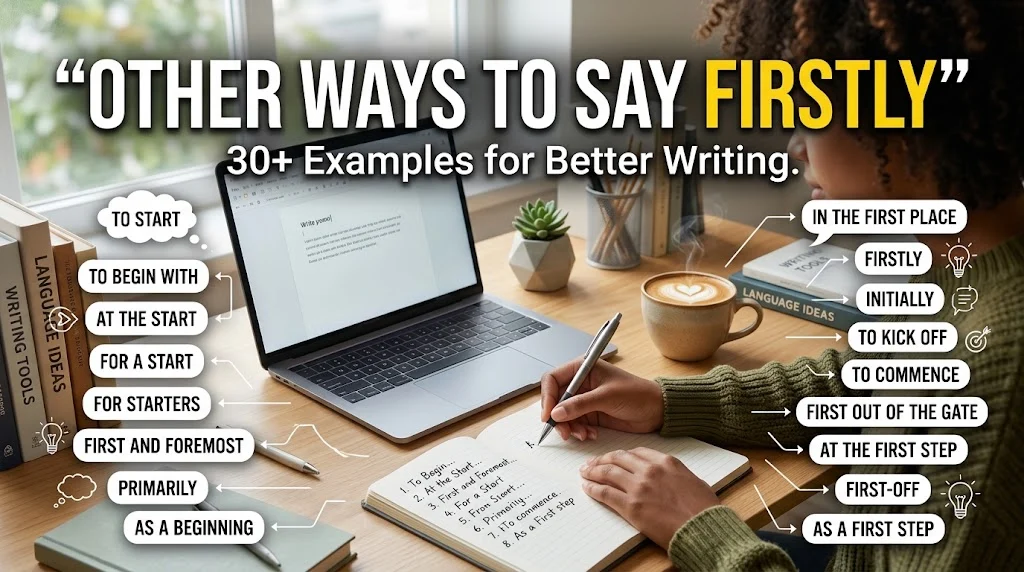
“Firstly” is a transitional adverb used to introduce the first point in a list, argument, or sequence. For more variety and precision, try alternatives like “First of all,” “To begin with,” “First and foremost,” “In the first place,” or “Initially.”
“Firstly” is one of the first linking words every English learner acquires. It appears in essays, presentations, emails, and everyday explanations. It signals that a list or argument is about to begin and helps the reader follow your structure.
This guide provides 30 practical alternatives with clear notes on tone, context, and audience. You will also learn to express excitement in English when introducing an idea and use professional reaction phrases that fit academic and business writing. Whether you are writing an essay, a report, or a casual message, these options will help you sound fluent and confident.
Pull Quote: “Transition words are the signposts of your writing. The right one guides your reader effortlessly.”
Quick Categories
Formal alternatives to “Firstly”
- First and foremost
- In the first instance
- To begin with
- Primarily
Pro Tip: Formal alternatives suit academic essays, official reports, and professional correspondence.
Casual alternatives
- First off
- For starters
- To start with
- First thing
Pro Tip: Casual options work well in spoken English and informal writing.
Professional alternatives
- To begin
- Initially
- At the outset
- In the first place
Pro Tip: Professional alternatives suit presentations, meetings, and business documents.
Informal expressions
- First up
- Number one
- Before anything else
- Let me start with
Pro Tip: Informal expressions belong in conversations, texts, and casual presentations.
Pull Quote: “The right tone makes your English sound professional and confident.”
Common Mistakes
- Using “firstly” without following with “secondly.”
Example: “Firstly, we need funding. Also, we need staff.” The structure is inconsistent. - Overusing “firstly” in every paragraph.
Example: “Firstly, I woke up. Firstly, I ate breakfast. Firstly, I left.” Repetition weakens clarity. - Using “firstly” in casual conversation.
Example: “Firstly, let me tell you about my weekend.” It sounds too formal for a chat. - Confusing “firstly” with “first.”
Example: “Firstly, I want to thank you” when “First, I want to thank you” sounds more natural. - Using it to introduce a single point.
Example: “Firstly, I enjoy reading.” There is no second point, so the transition is unnecessary.
What Does “Firstly” Mean?
Definition
It is an adverb used to introduce the first item in a list, sequence, or series of arguments.
Grammar Explanation
“Firstly” functions as a transitional adverb or sentence adverb. It usually appears at the beginning of a sentence and is followed by a comma. It is more common in British English, while American English often prefers “first.”
Example Sentence
“Firstly, we need to review the budget before approving the plan.”
When to Use “Firstly”
Common Contexts
- Academic writing: Structuring essays and research papers.
- Presentations: Introducing the first point in a sequence.
- Business reports: Organising recommendations.
- Everyday explanations: Listing reasons or steps.
- Speeches: Opening a formal address.
Spoken vs Written
- Spoken: Common in formal speeches and presentations.
- Written: Very common in academic and professional writing.
Formal vs Informal
- Formal: Standard in essays and reports.
- Informal: Acceptable but often replaced by “first off” or “for starters” in casual speech.
Is It Professional or Polite to Say “Firstly”?
Politeness vs Professionalism
“Firstly” is both polite and professional. It is widely accepted in academic and business writing. However, some style guides consider it dated and recommend “first” instead. In modern professional English, varying your transitions demonstrates stronger writing skill.
Business-Style Example
“To begin, I would like to outline the key objectives of this proposal.”
Polite? Yes
Professional? Yes, in most contexts
Pull Quote: “Variety in transitions shows control. Repetition shows habit.”
Pros and Cons of Using “Firstly”
Pros
- Simple and natural: Easy to use and understand.
- Friendly tone: Neutral and accessible.
- Common usage: Recognised in every English speaking country.
- Easy to understand: Requires no specialist vocabulary.
Cons
- Too informal for work: Rarely an issue, but can sound mechanical in formal writing.
- Overused: Loses impact through repetition.
- Limited emotional range: Cannot express emphasis or urgency.
- Not suitable for formal writing: Acceptable, but “first” is often preferred.
Other Ways to Say “Firstly” (With Examples)
These alternatives will help you sound more fluent, confident, and natural in different situations. Use them according to tone, context, and audience to express excitement, admiration, or approval.
1. First of all
Meaning: Before anything else.
Explanation: A common and slightly emphatic alternative.
Example Sentence: “First of all, I want to thank everyone for coming.”
Best Use: Speeches, presentations
Worst Use: Academic essays
Tone: Warm, direct, standard
Context Variability: Casual and professional
2. To begin with
Meaning: As the first point in a sequence.
Explanation: Formal and structured.
Example Sentence: “To begin with, we should review the current data.”
Best Use: Reports, essays
Worst Use: Casual chats
Tone: Formal, structured, neutral
Context Variability: Professional and written
3. First and foremost
Meaning: Above all else; most importantly.
Explanation: Emphasises priority.
Example Sentence: “First and foremost, safety must remain our priority.”
Best Use: Speeches, proposals
Worst Use: Casual texts
Tone: Formal, emphatic, strong
Context Variability: Professional and written
4. In the first place
Meaning: As the initial point or reason.
Explanation: Slightly formal and often used in arguments.
Example Sentence: “In the first place, the budget does not allow for this.”
Best Use: Arguments, debates
Worst Use: Casual conversation
Tone: Formal, argumentative, neutral
Context Variability: Professional and written
5. Initially
Meaning: At the beginning; at first.
Explanation: Focuses on time rather than sequence.
Example Sentence: “Initially, we planned to launch in March.”
Best Use: Reports, narratives
Worst Use: Lists, arguments
Tone: Formal, temporal, neutral
Context Variability: Professional and written
6. Primarily
Meaning: Mainly; chiefly.
Explanation: Emphasises importance rather than order.
Example Sentence: “The delay was primarily caused by supply issues.”
Best Use: Analysis, reports
Worst Use: Casual chats
Tone: Formal, analytical, precise
Context Variability: Professional and written
7. First off
Meaning: As the first point.
Explanation: Very casual and conversational.
Example Sentence: “First off, let me explain what happened.”
Best Use: Informal speech
Worst Use: Formal writing
Tone: Casual, conversational, friendly
Context Variability: Casual and spoken
8. For starters
Meaning: As a first point or example.
Explanation: Informal and often implies more will follow.
Example Sentence: “For starters, the price is too high.”
Best Use: Informal arguments
Worst Use: Formal reports
Tone: Casual, conversational, direct
Context Variability: Casual and spoken
9. To start with
Meaning: As the first consideration.
Explanation: Similar to “to begin with” but slightly more casual.
Example Sentence: “To start with, let us look at the numbers.”
Best Use: Meetings, discussions
Worst Use: Academic essays
Tone: Neutral, practical, friendly
Context Variability: Professional and spoken
10. First thing
Meaning: As the very first action.
Explanation: Informal and practical.
Example Sentence: “First thing, we need to call the supplier.”
Best Use: Task lists, plans
Worst Use: Formal writing
Tone: Informal, practical, direct
Context Variability: Casual and spoken
11. To begin
Meaning: As the opening point.
Explanation: Formal and concise.
Example Sentence: “To begin, I would like to outline the agenda.”
Best Use: Presentations, meetings
Worst Use: Casual texts
Tone: Formal, structured, polite
Context Variability: Professional and spoken
12. At the outset
Meaning: At the very beginning.
Explanation: Formal and slightly literary.
Example Sentence: “At the outset, we agreed on three key goals.”
Best Use: Reports, narratives
Worst Use: Casual chats
Tone: Formal, literary, precise
Context Variability: Professional and written
13. In the first instance
Meaning: As the first step or stage.
Explanation: Very formal and procedural.
Example Sentence: “In the first instance, please contact the support team.”
Best Use: Official instructions
Worst Use: Casual conversation
Tone: Formal, procedural, precise
Context Variability: Professional and written
14. First up
Meaning: As the first item.
Explanation: Informal and often used in media.
Example Sentence: “First up, we have the weather forecast.”
Best Use: Broadcasting, informal speech
Worst Use: Academic writing
Tone: Casual, media, energetic
Context Variability: Casual and spoken
15. Number one
Meaning: As the most important or first point.
Explanation: Informal and emphatic.
Example Sentence: “Number one, we need to cut costs.”
Best Use: Informal meetings
Worst Use: Formal reports
Tone: Informal, direct, emphatic
Context Variability: Casual and spoken
16. Before anything else
Meaning: Prior to all other considerations.
Explanation: Emphasises priority.
Example Sentence: “Before anything else, we must ensure everyone is safe.”
Best Use: Emergency, priority
Worst Use: Routine lists
Tone: Urgent, emphatic, direct
Context Variability: Professional and spoken
17. Let me start with
Meaning: I will begin by discussing.
Explanation: Personal and conversational.
Example Sentence: “Let me start with the most important point.”
Best Use: Presentations, speeches
Worst Use: Formal essays
Tone: Personal, conversational, warm
Context Variability: Professional and spoken
18. The first point is
Meaning: Introducing the initial item.
Explanation: Very clear and structured.
Example Sentence: “The first point is that we need more data.”
Best Use: Academic writing
Worst Use: Casual chats
Tone: Formal, structured, clear
Context Variability: Professional and written
19. I would like to begin by
Meaning: A polite way to introduce the first point.
Explanation: Formal and courteous.
Example Sentence: “I would like to begin by thanking the committee.”
Best Use: Speeches, formal letters
Worst Use: Quick texts
Tone: Formal, polite, respectful
Context Variability: Professional and written
20. Starting with
Meaning: Beginning with a specific item.
Explanation: Neutral and flexible.
Example Sentence: “Starting with the budget, we need to review all expenses.”
Best Use: Reports, lists
Worst Use: Emotional contexts
Tone: Neutral, practical, structured
Context Variability: Professional and written
21. Beginning with
Meaning: As the first item in a sequence.
Explanation: Formal and precise.
Example Sentence: “Beginning with the introduction, the report covers five sections.”
Best Use: Academic writing
Worst Use: Casual speech
Tone: Formal, precise, academic
Context Variability: Professional and written
22. In the beginning
Meaning: At the start of a process or period.
Explanation: Often used in narratives.
Example Sentence: “In the beginning, the project faced many challenges.”
Best Use: Narratives, stories
Worst Use: Lists, arguments
Tone: Narrative, reflective, neutral
Context Variability: Professional and written
23. As a starting point
Meaning: As an initial basis for discussion.
Explanation: Suggests more will follow.
Example Sentence: “As a starting point, let us review the current policy.”
Best Use: Meetings, proposals
Worst Use: Casual chats
Tone: Practical, structured, neutral
Context Variability: Professional and spoken
24. One of the first things
Meaning: Among the earliest considerations.
Explanation: Softer and less absolute.
Example Sentence: “One of the first things we noticed was the noise.”
Best Use: Narratives, reports
Worst Use: Formal arguments
Tone: Reflective, neutral, descriptive
Context Variability: Professional and written
25. The first thing to note is
Meaning: Introducing the initial observation.
Explanation: Formal and analytical.
Example Sentence: “The first thing to note is the sharp rise in costs.”
Best Use: Analysis, reports
Worst Use: Casual chats
Tone: Formal, analytical, precise
Context Variability: Professional and written
26. Above all
Meaning: More than anything else.
Explanation: Emphasises priority over sequence.
Example Sentence: “Above all, we must protect the client’s interests.”
Best Use: Speeches, proposals
Worst Use: Routine lists
Tone: Emphatic, formal, strong
Context Variability: Professional and written
27. First things first
Meaning: Deal with the most important matter first.
Explanation: Idiomatic and practical.
Example Sentence: “First things first, let us confirm the deadline.”
Best Use: Meetings, plans
Worst Use: Academic essays
Tone: Practical, informal, direct
Context Variability: Casual and spoken
28. In the opening
Meaning: At the start of a speech or text.
Explanation: Specific to speeches and written works.
Example Sentence: “In the opening, the author sets out three main themes.”
Best Use: Literature, speeches
Worst Use: Casual chats
Tone: Formal, literary, analytical
Context Variability: Professional and written
29. As an initial step
Meaning: As the first action in a process.
Explanation: Procedural and practical.
Example Sentence: “As an initial step, we will conduct a survey.”
Best Use: Project plans
Worst Use: Emotional contexts
Tone: Practical, formal, structured
Context Variability: Professional and written
30. To kick things off
Meaning: To begin an event or activity.
Explanation: Informal and energetic.
Example Sentence: “To kick things off, let us hear from our first speaker.”
Best Use: Events, presentations
Worst Use: Formal reports
Tone: Energetic, informal, friendly
Context Variability: Casual and spoken
Pull Quote: “Professional reaction phrases and clear transitions both show the same thing: you respect your reader’s time.”
Mini Quiz / Self-Check
- Scenario: You are writing a formal academic essay. Which transition fits best?
- A) First off.
- B) To begin with.
- C) To kick things off.
- Scenario: You are hosting an event and introducing the first speaker. Which is most natural?
- A) In the first instance.
- B) To kick things off.
- C) Primarily.
- Scenario: You are writing a business report recommending action. Which fits best?
- A) First and foremost.
- B) First up.
- C) For starters.
- Scenario: Which phrase is the most informal?
- A) At the outset.
- B) First off.
- C) Initially.
Comparison Table: Top Alternatives
| Phrase | Tone | Best Use |
| First of all | Warm, direct | Speeches, presentations |
| To begin with | Formal, structured | Reports, essays |
| First and foremost | Formal, emphatic | Speeches, proposals |
| Initially | Formal, temporal | Reports, narratives |
| First off | Casual, conversational | Informal speech |
| For starters | Casual, direct | Informal arguments |
| To begin | Formal, polite | Presentations, meetings |
| At the outset | Formal, literary | Reports, narratives |
| First things first | Practical, informal | Meetings, plans |
| To kick things off | Energetic, informal | Events, presentations |
FAQs
1. What is a formal alternative to “firstly”?
“To begin with,” “First and foremost,” and “In the first instance” are strong formal alternatives suitable for academic essays and official reports.
2. Is “firstly” correct in English?
“Firstly” is grammatically correct and widely used in British English, though some style guides prefer “first” in modern writing.
3. What can I say instead of “firstly” in an essay?
“To begin with,” “First of all,” and “Initially” are excellent alternatives for academic writing.
4. What is the difference between “firstly” and “first”?
Both are correct, but “first” is more common in modern English and often preferred by style guides for its simplicity.
5. What can I say instead of “firstly” in casual conversation?
“First off,” “For starters,” and “First things first” are natural and informal alternatives for everyday speech.
Conclusion
Learning other ways to say firstly gives you the flexibility to structure your ideas with variety and precision. Whether you are writing an academic essay, presenting to a team, or chatting with friends, the right transition makes your English sound fluent and natural. These alternatives to firstly help you move beyond one overused word and into richer, more expressive writing.
Practise by varying your transition words in every piece of writing you produce. Pay close attention to tone and context, because the right phrase depends on the situation and the audience. With steady practice, these informal expressions in English and their formal counterparts will become part of your everyday fluency.

Stephen King is an American writer and language enthusiast who enjoys creating clear, practical content that helps readers communicate with confidence. His work at QuickResponsess.com focuses on making English easier to understand through simple explanations and everyday examples.