Quick Answer
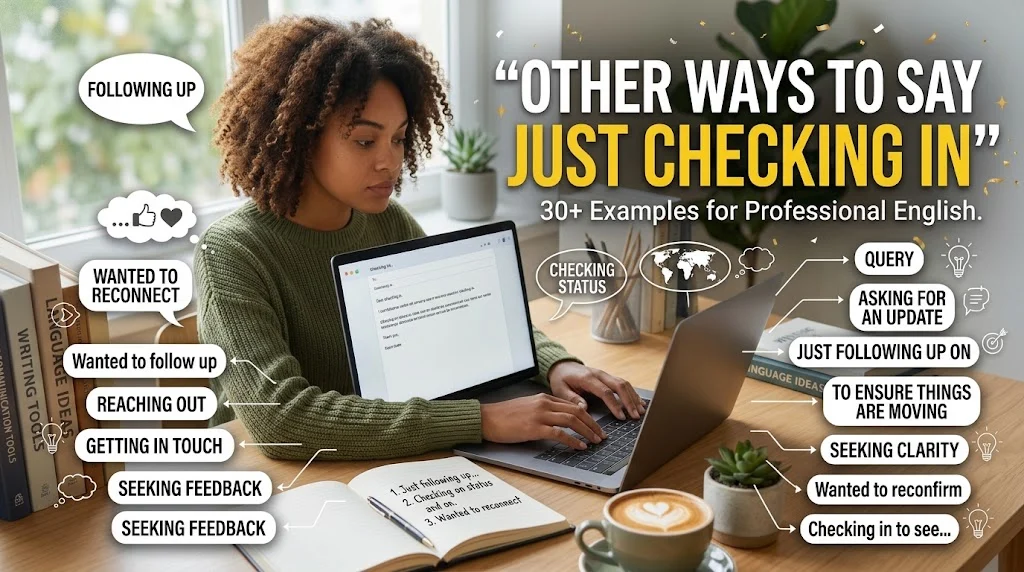
“Just checking in” is a polite phrase used to ask for an update or see how someone is doing. For more variety and precision, try alternatives like “Following up,” “Touching base,” “Wanted to see how things are going,” “Circling back,” or “Just wanted to check in on you.”
“Just checking in” is one of the most useful phrases in modern professional English. It appears in emails, chat messages, and phone calls when someone wants an update without sounding demanding. It softens the request by framing it as a friendly enquiry rather than pressure.
This guide provides 30 practical alternatives with meanings, examples, and notes on tone. You will learn how to follow up professionally, how to show genuine care, and how to express excitement in English when you are eager to hear good news. Whether you are writing to a client, a colleague, or a friend, these options will help you sound natural and confident.
Pull Quote: “A good follow up does not chase people. It gives them an easy way to respond.”
Quick Categories
Formal alternatives to “Just checking in”
- I am writing to follow up on our previous correspondence.
- I would appreciate an update at your earliest convenience.
- May I kindly request a status update.
- I am reaching out regarding the matter discussed previously.
Pro Tip: Formal alternatives suit client emails, official enquiries, and situations where hierarchy matters.
Casual alternatives
- How are things going?
- Any news?
- What is the latest?
- How is it going?
Pro Tip: Casual options work with friends, close colleagues, and informal chat threads.
Professional alternatives
- Following up on our last conversation.
- Touching base regarding the project timeline.
- Wanted to see where things stand.
- Circling back on my previous message.
Pro Tip: Professional alternatives should name the specific topic so the recipient knows exactly what you mean.
Informal expressions
- Just wanted to see how you are doing.
- Hope all is well, any updates?
- Checking in, no rush.
- How are you getting on?
Pro Tip: Informal expressions belong in texts, chat messages, and conversations with people you know well.
Pull Quote: “The right tone makes your English sound professional and confident.”
Common Mistakes
- Using it with no context or topic.
Example: “Just checking in.” with no reference to what you are checking in about. - Using it when you actually need something urgent.
Example: “Just checking in” when a deadline has already passed. This sounds passive and unclear. - Repeating it too often in one thread.
Example: “Just checking in. Just checking in again. Just checking in once more.” This feels like pressure. - Using it in a formal complaint or escalation.
Example: “Just checking in about the refund I was promised three weeks ago.” The phrase softens a serious issue too much. - Using it to avoid stating your purpose.
Example: “Just checking in” when you actually want a decision, a payment, or approval. Be direct when it matters.
What Does “Just Checking In” Mean?
Definition
It is a polite phrase used to request an update, confirm progress, or show friendly interest in someone’s situation.
Grammar Explanation
“Just” is an adverb meaning simply or only, “checking” is the present participle of the verb “check,” and “in” is a particle that completes the phrasal verb “check in.” Together they form a softening expression often used at the start of a message.
Example Sentence
“Just checking in to see if you received the documents I sent yesterday.”
When to Use “Just Checking In”
Common Contexts
- Workplace: Asking a colleague for a project update.
- Client communication: Following up on a proposal or invoice.
- Customer service: Confirming whether an issue has been resolved.
- Personal life: Seeing how a friend or family member is doing.
- Recruitment: Contacting a candidate about an application.
Spoken vs Written
- Spoken: Common in phone calls and informal check ins.
- Written: Extremely common in emails and chat messages.
Formal vs Informal
- Formal: Acceptable in most business settings, but can sound vague.
- Informal: The default choice in everyday communication.
Is It Professional or Polite to Say “Just Checking In”?
Politeness vs Professionalism
The phrase is polite because it avoids pressure. However, it can sound vague or even passive in professional writing. A specific follow up usually reads as more professional and more respectful of the recipient’s time.
Business-Style Example
“I am following up on the proposal sent on Monday. Could you share an update by Friday?”
Polite? Yes
Professional? Sometimes, but more specific wording is usually stronger
Pull Quote: “Clarity is a form of respect. Vague messages waste the reader’s time.”
Pros and Cons of Using “Just Checking In”
Pros
- Simple and natural: Easy to say and write.
- Friendly tone: Feels low pressure and non demanding.
- Common usage: Instantly understood in most workplaces.
- Easy to understand: Requires no specialist vocabulary.
Cons
- Too informal for work: Can sound vague in formal correspondence.
- Overused: Loses impact through repetition.
- Limited emotional range: Cannot express urgency or genuine concern.
- Not suitable for formal writing: Avoid in official reports and legal correspondence.
Other Ways to Say “Just Checking In” (With Examples)
These alternatives will help you sound more fluent, confident, and natural in different situations. Use them according to tone, context, and audience to express excitement, admiration, or approval.
1. Following up
Meaning: Checking on something discussed earlier.
Explanation: The most common professional alternative.
Example Sentence: “Following up on our call last week about the contract.”
Best Use: Business emails
Worst Use: Casual chats
Tone: Professional, neutral, standard
Context Variability: Professional and written
2. Touching base
Meaning: Making brief contact to stay updated.
Explanation: Friendly and collaborative in tone.
Example Sentence: “Touching base to see where things stand with the design.”
Best Use: Workplace, teams
Worst Use: Formal complaints
Tone: Friendly, professional, collaborative
Context Variability: Professional and spoken
3. Wanted to see how things are going
Meaning: Asking for a general progress update.
Explanation: Warm and conversational.
Example Sentence: “Wanted to see how things are going with the new client.”
Best Use: Colleagues, friends
Worst Use: Formal letters
Tone: Warm, curious, casual
Context Variability: Casual and spoken
4. Circling back
Meaning: Returning to a topic discussed earlier.
Explanation: Common in corporate English.
Example Sentence: “Circling back on my previous email about the budget.”
Best Use: Business emails
Worst Use: Personal texts
Tone: Professional, direct, neutral
Context Variability: Professional and written
5. Just wanted to check in on you
Meaning: A personal version that shows care.
Explanation: Focuses on the person rather than the task.
Example Sentence: “Just wanted to check in on you after last week.”
Best Use: Personal, wellbeing
Worst Use: Client enquiries
Tone: Caring, warm, personal
Context Variability: Casual and spoken
6. I am writing to follow up
Meaning: A formal way to open a follow up message.
Explanation: Common in official correspondence.
Example Sentence: “I am writing to follow up on the invoice sent on 3 June.”
Best Use: Formal emails
Worst Use: Text messages
Tone: Formal, polite, professional
Context Variability: Professional and written
7. Any update on this
Meaning: A direct request for news.
Explanation: Short and efficient.
Example Sentence: “Any update on this? The client is asking.”
Best Use: Workplace, urgent
Worst Use: Sensitive topics
Tone: Direct, brief, practical
Context Variability: Professional and spoken
8. Wanted to see where things stand
Meaning: Asking for the current status.
Explanation: Neutral and businesslike.
Example Sentence: “Wanted to see where things stand with the supplier.”
Best Use: Project management
Worst Use: Personal messages
Tone: Professional, neutral, practical
Context Variability: Professional and written
9. Hope all is well, just checking in
Meaning: A friendly greeting combined with a follow up.
Explanation: Softens the request with warmth.
Example Sentence: “Hope all is well, just checking in about the report.”
Best Use: Colleagues, clients
Worst Use: Formal reports
Tone: Warm, polite, friendly
Context Variability: Professional and written
10. Could you share a quick update
Meaning: A polite request for brief news.
Explanation: Respectful of the recipient’s time.
Example Sentence: “Could you share a quick update before the end of the day?”
Best Use: Workplace, deadlines
Worst Use: Casual chats
Tone: Polite, professional, clear
Context Variability: Professional and written
11. Just wanted to see if you had a chance to look at this
Meaning: A gentle reminder about something sent earlier.
Explanation: Very common in email follow ups.
Example Sentence: “Just wanted to see if you had a chance to look at this proposal.”
Best Use: Client emails
Worst Use: Personal texts
Tone: Gentle, polite, patient
Context Variability: Professional and written
12. Reaching out regarding
Meaning: Making contact about a specific topic.
Explanation: Formal and clear in purpose.
Example Sentence: “Reaching out regarding the shipment scheduled for Monday.”
Best Use: Formal emails
Worst Use: Quick chats
Tone: Formal, clear, professional
Context Variability: Professional and written
13. How are things on your end
Meaning: Asking about someone’s side of a project.
Explanation: Collaborative and friendly.
Example Sentence: “How are things on your end with the testing phase?”
Best Use: Teams, projects
Worst Use: Formal letters
Tone: Friendly, collaborative, casual
Context Variability: Professional and spoken
14. Checking in for a status update
Meaning: A clear request for progress information.
Explanation: Direct but still polite.
Example Sentence: “Checking in for a status update on the recruitment drive.”
Best Use: Workplace
Worst Use: Personal messages
Tone: Direct, professional, clear
Context Variability: Professional and written
15. Wanted to follow up on our conversation
Meaning: Referring back to a previous discussion.
Explanation: Specific and professional.
Example Sentence: “Wanted to follow up on our conversation about the new role.”
Best Use: Business, recruitment
Worst Use: Casual chats
Tone: Professional, specific, polite
Context Variability: Professional and written
16. Any news on this front
Meaning: Asking for updates on a specific matter.
Explanation: Slightly informal but professional.
Example Sentence: “Any news on this front? The team is waiting.”
Best Use: Workplace
Worst Use: Formal letters
Tone: Direct, informal, practical
Context Variability: Professional and spoken
17. Just a gentle reminder
Meaning: A soft prompt about something pending.
Explanation: Common after a previous unanswered message.
Example Sentence: “Just a gentle reminder about the feedback I requested.”
Best Use: Email follow ups
Worst Use: Urgent escalation
Tone: Gentle, polite, patient
Context Variability: Professional and written
18. Wanted to touch base about
Meaning: A friendly way to make brief contact.
Explanation: Collaborative and warm.
Example Sentence: “Wanted to touch base about the training schedule.”
Best Use: Colleagues, clients
Worst Use: Formal reports
Tone: Friendly, professional, collaborative
Context Variability: Professional and spoken
19. How is everything going with
Meaning: Asking about progress on a specific matter.
Explanation: Warm and conversational.
Example Sentence: “How is everything going with the new website?”
Best Use: Colleagues, friends
Worst Use: Formal writing
Tone: Warm, curious, casual
Context Variability: Casual and spoken
20. Just wanted to see how you are getting on
Meaning: A caring enquiry about progress.
Explanation: Common in British English.
Example Sentence: “Just wanted to see how you are getting on with the report.”
Best Use: Colleagues, mentoring
Worst Use: Formal letters
Tone: Warm, supportive, casual
Context Variability: Casual and spoken
21. Following up on my previous message
Meaning: Referring to an earlier email or note.
Explanation: Clear and professional.
Example Sentence: “Following up on my previous message regarding the invoice.”
Best Use: Business emails
Worst Use: Personal texts
Tone: Professional, direct, neutral
Context Variability: Professional and written
22. I hope this finds you well
Meaning: A polite opener before a follow up.
Explanation: Formal and traditional.
Example Sentence: “I hope this finds you well. I am following up on the proposal.”
Best Use: Formal emails
Worst Use: Chat messages
Tone: Formal, polite, traditional
Context Variability: Professional and written
23. Wanted to see if there is any progress
Meaning: A direct enquiry about advancement.
Explanation: Clear and efficient.
Example Sentence: “Wanted to see if there is any progress on the hiring process.”
Best Use: Workplace
Worst Use: Casual chats
Tone: Direct, professional, practical
Context Variability: Professional and written
24. Just wondered if you had any thoughts
Meaning: A soft request for feedback or opinion.
Explanation: Very polite and non demanding.
Example Sentence: “Just wondered if you had any thoughts on the draft.”
Best Use: Creative, feedback
Worst Use: Urgent decisions
Tone: Gentle, polite, open
Context Variability: Professional and spoken
25. Checking in to see if you need anything
Meaning: Offering help rather than asking for updates.
Explanation: Shows initiative and care.
Example Sentence: “Checking in to see if you need anything before the launch.”
Best Use: Supportive, teams
Worst Use: Formal enquiries
Tone: Supportive, warm, proactive
Context Variability: Professional and spoken
26. Just seeing if there is anything new
Meaning: A light enquiry about updates.
Explanation: Casual and low pressure.
Example Sentence: “Just seeing if there is anything new on the project.”
Best Use: Colleagues
Worst Use: Formal writing
Tone: Casual, light, friendly
Context Variability: Casual and spoken
27. Wanted to check on the status of
Meaning: A direct status enquiry.
Explanation: Professional and specific.
Example Sentence: “Wanted to check on the status of the shipment.”
Best Use: Business, logistics
Worst Use: Personal messages
Tone: Professional, direct, neutral
Context Variability: Professional and written
28. Hope you are doing well, any updates
Meaning: A warm greeting combined with a request.
Explanation: Friendly and efficient.
Example Sentence: “Hope you are doing well, any updates on the vendor contract?”
Best Use: Clients, colleagues
Worst Use: Formal reports
Tone: Warm, polite, friendly
Context Variability: Professional and written
29. Just wanted to make sure nothing is blocking you
Meaning: Checking whether obstacles exist.
Explanation: Helpful and proactive.
Example Sentence: “Just wanted to make sure nothing is blocking you on the handover.”
Best Use: Project management
Worst Use: Casual chats
Tone: Supportive, practical, professional
Context Variability: Professional and written
30. How are you getting along with
Meaning: A friendly enquiry about progress.
Explanation: Common in British English.
Example Sentence: “How are you getting along with the new software?”
Best Use: Colleagues, learning
Worst Use: Formal letters
Tone: Friendly, supportive, casual
Context Variability: Casual and spoken
Pull Quote: “Professional reaction phrases and clear follow ups both show the same thing: you respect the other person’s time.”
Mini Quiz / Self-Check
- Scenario: You are writing to a client about an overdue invoice. Which fits best?
- A) Just checking in.
- B) I am writing to follow up on the invoice sent on 3 June.
- C) How are things on your end?
- Scenario: You are messaging a colleague about a project. Which is most natural?
- A) Touching base to see where things stand with the design.
- B) I wish to express my sincere enquiry.
- C) Any news on this front.
- Scenario: You are texting a friend to see how they are doing after a hard week. Which is most appropriate?
- A) Following up on our previous correspondence.
- B) Just wanted to check in on you.
- C) Circling back on my previous message.
- Scenario: Which phrase is generally too vague for a formal business email?
- A) Just checking in.
- B) I am writing to follow up on the proposal.
- C) Could you share a quick update?
Comparison Table: Top Alternatives
| Phrase | Tone | Best Use |
| Following up | Professional, standard | Business emails |
| Touching base | Friendly, collaborative | Workplace, teams |
| Circling back | Professional, direct | Corporate emails |
| Wanted to see how things are going | Warm, casual | Colleagues, friends |
| Just wanted to check in on you | Caring, personal | Personal wellbeing |
| I am writing to follow up | Formal, polite | Official correspondence |
| Any update on this | Direct, brief | Urgent workplace |
| Could you share a quick update | Polite, clear | Deadlines |
| Checking in to see if you need anything | Supportive, proactive | Team support |
| Just a gentle reminder | Gentle, patient | Email follow ups |
FAQs
1. What is a formal alternative to “just checking in”?
“I am writing to follow up on our previous correspondence” or “May I kindly request a status update” are strong formal alternatives suitable for client emails and official enquiries.
2. How do I follow up professionally without sounding pushy?
Be specific about the topic and offer an easy way to respond, for example “Could you share a quick update by Friday if possible?”
3. What can I say instead of “just checking in” in a text message?
“How are things going?”, “Any news?”, and “Just wanted to check in on you” are natural and friendly options for texts.
4. Is “just checking in” too informal for business emails?
It is acceptable in most workplaces but can sound vague. A specific follow up such as “Following up on the proposal sent Monday” reads as more professional.
5. What is the difference between “just checking in” and “following up”?
“Just checking in” is softer and more personal, while “following up” is more specific and typically refers to a previous message or discussion.
Conclusion
Learning other ways to say just checking in gives you the ability to follow up with clarity, warmth, and professionalism. Whether you are contacting a client, a colleague, or a friend, the right phrase makes your English sound intentional rather than automatic. These alternatives to just checking in help you move beyond one overused opener and into more effective communication.
Practise by rewriting one follow up message each day, whether it is an email, a chat, or a spoken enquiry. Pay close attention to tone and audience, because the right phrase depends on the relationship and the purpose. With steady practice, these informal expressions in English and their formal counterparts will become part of your everyday fluency.

Stephen King is an American writer and language enthusiast who enjoys creating clear, practical content that helps readers communicate with confidence. His work at QuickResponsess.com focuses on making English easier to understand through simple explanations and everyday examples.