Quick Answer 🔥
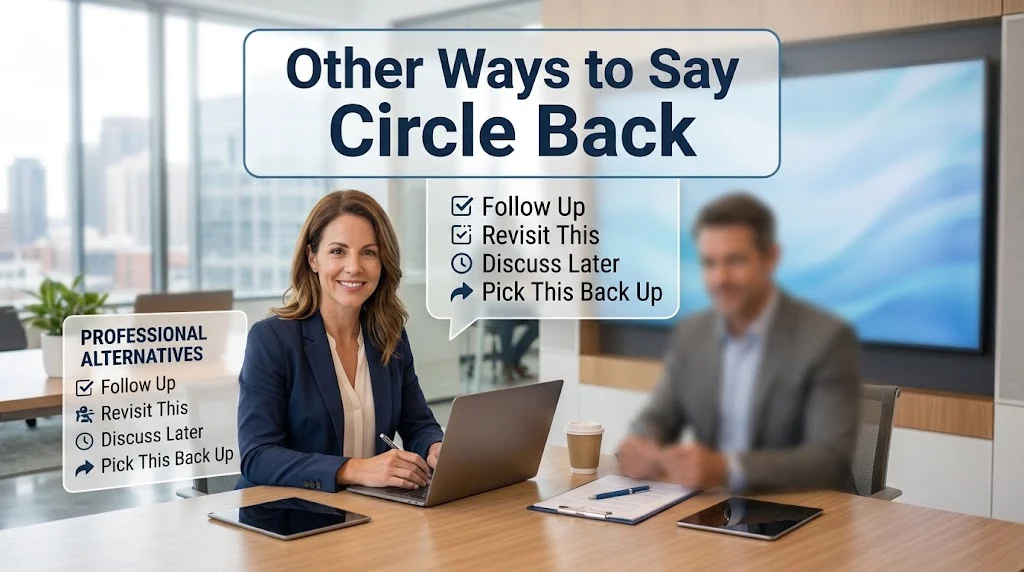
Looking for alternatives to circle back? Here are 5 top options: Follow up, Revisit, Touch base, Get back to, and Return to this topic.
The phrase circle back has become a staple of modern workplace communication. It means to return to a topic, conversation, or task at a later time often after gathering more information or when time runs out in a meeting. While useful, overusing it can make you sound repetitive or vague.
Learning alternatives to circle back helps you sound more fluent, confident, and professionally aware. Whether you need to express excitement in English about revisiting an idea or simply want to vary your vocabulary, having multiple options at your disposal allows you to match your tone to any situation from formal boardroom emails to casual Slack messages.
Quick Categories
Formal Alternatives to “Circle Back”
- Follow up · Revisit · Return to this matter · Resume the discussion · Readdress this issue · Re examine · Continue discussions later
Casual Alternatives
- Check back · Loop back · Ping back · Catch up later · Come back to this
Professional Alternatives
- Touch base · Reconnect · Get back to · Pick up where we left off · Reengage · Review again
Informal Expressions
- Get back to you · Check in again · Bring up again · Circle around · Swing back
💡 Pro Tip: Match your alternative to your audience. Use formal options with clients and senior leaders; save casual phrases for close colleagues and team chats.
Common Mistakes Using “Circle Back”
| Mistake | Example |
| Using it without a timeline | “Let’s circle back on this.” (When? Who?) |
| Overusing it in one conversation | “Let’s circle back, then circle back again.” |
| Using it in formal written reports | Avoid in executive summaries or legal documents |
| Assuming everyone understands it | Non native speakers may find it confusing |
| Using it to avoid decisions | Comes across as evasive or uncommitted |
“Circle back” ranked as the top piece of workplace jargon workers could do without.
What Does “Circle Back” Mean?
Circle back is a phrasal verb meaning to return to a topic, follow up, or revisit an issue at a later time.
Grammar note: It functions as a separable phrasal verb. You can say “circle back to this” or “circle back on this.”
Example sentence: “Let’s circle back to the budget discussion after the Q3 numbers are available.”
When to Use “Circle Back”
- Meetings when time runs out and discussion needs to continue later
- Email follow ups to signal you’ll provide more information
- Project updates when waiting on data or approvals
- Client communication to postpone without ending the conversation
- Spoken English casual office conversations and phone calls
- Written English acceptable but often overused in emails
Spoken vs Written: More common and natural in spoken meetings; in writing, clearer alternatives are often preferred.
Formal vs Informal: Neutral in spoken business contexts but slightly informal for formal written corporate communication.
Is It Professional or Polite to Say “Circle Back”?
Polite? ✔️ Yes it’s generally considered courteous and non confrontational.
Professional? ❌ Not always it can feel vague, overused, or overly casual in formal settings.
Business example: “I’ll circle back with you after I’ve reviewed the proposal.”
💡 The phrase is clear among English speaking professionals but can feel vague to non native speakers.
Pros and Cons of Using “Circle Back”
Pros:
- Simple and natural in spoken English
- Friendly and approachable tone
- Common and widely understood in business
- Easy to say and remember
Cons:
- Too informal for formal written work
- Overused and has lost impact
- Limited emotional range sounds robotic
- Not suitable for formal or academic writing
Other Ways to Say “Circle Back” (With Examples)
These alternatives will help you sound more fluent, confident, and natural in different situations. Use them according to tone, context, and audience to communicate with precision and professionalism.
1. Phrase: Follow Up
Meaning: To take action after a previous discussion or task.
Explanation: Signals commitment and professionalism; widely used in emails and meetings.
Example Sentence: “I’ll follow up with the client tomorrow morning.”
Best Use: Formal emails
Worst Use: Casual texting
Tone: Professional, clear
Context Variability: Professional “Following up on our conversation from last week”; Casual “Just following up!”
2. Phrase: Revisit
Meaning: To return to a topic for review or discussion.
Explanation: Neutral and structured; ideal for formal reports and presentations.
Example Sentence: “We should revisit the proposal during next week’s meeting.”
Best Use: Academic, formal reports
Worst Use: Casual conversations
Tone: Formal, neutral
Context Variability: Professional “Let’s revisit this when we have more data”; Casual “Let’s revisit this later.”
3. Phrase: Touch Base
Meaning: To reconnect briefly about a project or task.
Explanation: Friendly and casual way to check in without being formal.
Example Sentence: “Let’s touch base tomorrow about the project timeline.”
Best Use: Team check ins
Worst Use: Formal client emails
Tone: Friendly, approachable
Context Variability: Professional “I wanted to touch base on the budget”; Casual “Let’s touch base soon.”
4. Phrase: Get Back To
Meaning: To respond or reply at a later time.
Explanation: Direct, simple, and universally understood in both spoken and written English.
Example Sentence: “I’ll get back to you once I have the final numbers.”
Best Use: All contexts
Worst Use: Formal legal documents
Tone: Neutral, straightforward
Context Variability: Professional “I’ll get back to you by Friday”; Casual “I’ll get back to you later.”
5. Phrase: Return to This Matter
Meaning: To resume discussion on a specific issue.
Explanation: Polite and professional phrasing for executive communication.
Example Sentence: “Let’s return to this matter once we have additional data.”
Best Use: Executive communication
Worst Use: Informal messages
Tone: Formal, respectful
Context Variability: Professional “We will return to this matter next quarter.”
6. Phrase: Reconnect
Meaning: To re establish contact about a previous topic.
Explanation: Suggests ongoing relationship and follow through.
Example Sentence: “I’d like to reconnect on this after the holiday break.”
Best Use: Professional follow ups
Worst Use: Urgent matters
Tone: Warm, professional
Context Variability: Professional “Let’s reconnect once the project launches.”
7. Phrase: Resume the Discussion
Meaning: To continue a paused conversation.
Explanation: Direct and clear; signals intentional follow through.
Example Sentence: “We will resume the discussion during tomorrow’s meeting.”
Best Use: Project emails
Worst Use: Casual conversation
Tone: Formal, direct
Context Variability: Professional “We’ll resume the discussion after the break.”
8. Phrase: Check Back
Meaning: To return or follow up later.
Explanation: Slightly conversational but appropriate for workplace follow ups.
Example Sentence: “I’ll check back with you next week to see how things are going.”
Best Use: Coworker follow ups
Worst Use: Formal executive emails
Tone: Conversational, friendly
Context Variability: Professional “Check back after the data is available”; Casual “Check back later.”
9. Phrase: Readdress This Issue
Meaning: To discuss again for resolution or refinement.
Explanation: Suggests careful reconsideration and problem solving.
Example Sentence: “We will readdress this issue during the quarterly review.”
Best Use: Problem solving emails
Worst Use: Friendly follow ups
Tone: Formal, solution oriented
Context Variability: Professional “Let’s readdress this after the audit.”
10. Phrase: Loop Back
Meaning: To return to a topic in a casual, conversational tone.
Explanation: Informal alternative that feels softer than “circle back”.
Example Sentence: “Let’s loop back on this after lunch.”
Best Use: Team chats, casual emails
Worst Use: Formal client communication
Tone: Casual, friendly
Context Variability: Casual “Loop back to me when you’re free.”
11. Phrase: Continue the Conversation
Meaning: To keep discussing a topic at a later time.
Explanation: Warm and inclusive phrasing for ongoing collaboration.
Example Sentence: “Let’s continue this conversation at our meeting tomorrow.”
Best Use: Collaborative settings
Worst Use: One way updates
Tone: Inclusive, professional
Context Variability: Professional “We’ll continue this conversation next week.”
12. Phrase: Reengage on This Topic
Meaning: To become involved again in a discussion.
Explanation: Suggests active participation and renewed focus.
Example Sentence: “I’d like to reengage on this topic after the team review.”
Best Use: Project updates
Worst Use: Quick check ins
Tone: Professional, active
Context Variability: Professional “Let’s reengage once we have the prototype.”
13. Phrase: Pick Up Where We Left Off
Meaning: To continue from the previous stopping point.
Explanation: Clear and natural phrasing for resuming discussions.
Example Sentence: “Let’s pick up where we left off in our last meeting.”
Best Use: Follow up meetings
Worst Use: Formal written reports
Tone: Natural, conversational
Context Variability: Professional “We’ll pick up where we left off on Thursday.”
14. Phrase: Come Back to This
Meaning: To return to a topic later.
Explanation: Simple and direct; works in most contexts.
Example Sentence: “Can we come back to this point after the presentation?”
Best Use: Meetings, discussions
Worst Use: Formal documents
Tone: Neutral, clear
Context Variability: Professional “Let’s come back to this after the break”; Casual “Come back to this later.”
15. Phrase: Review This Again
Meaning: To examine or consider something once more.
Explanation: Emphasizes careful re evaluation.
Example Sentence: “Let’s review this again once we have the updated figures.”
Best Use: Decision making contexts
Worst Use: Quick updates
Tone: Thorough, professional
Context Variability: Professional “We’ll review this again in the next sprint.”
16. Phrase: Re examine This Matter
Meaning: To review with careful analysis.
Explanation: Emphasizes thorough consideration and due diligence.
Example Sentence: “We will re examine this matter after receiving client feedback.”
Best Use: Academic, legal contexts
Worst Use: Casual emails
Tone: Formal, analytical
Context Variability: Professional “Let’s re examine this before the board meeting.”
17. Phrase: Follow Through On
Meaning: To complete an action or commitment.
Explanation: Signals reliability and accountability.
Example Sentence: “I’ll follow through on this and update you by Wednesday.”
Best Use: Action oriented follow ups
Worst Use: Vague discussions
Tone: Committed, reliable
Context Variability: Professional “Following through on our previous discussion.”
18. Phrase: Return With an Update
Meaning: To come back after gathering information.
Explanation: Clear and specific; sets expectations for new information.
Example Sentence: “I’ll return with an update on the budget by Friday.”
Best Use: Status updates
Worst Use: Brainstorming sessions
Tone: Professional, specific
Context Variability: Professional “I’ll return with an update once I have the data.”
19. Phrase: Check In Again
Meaning: To reconnect or follow up.
Explanation: Friendly and non intrusive phrasing for follow ups.
Example Sentence: “I’ll check in again next week to see how things are progressing.”
Best Use: Team follow ups
Worst Use: Formal executive updates
Tone: Friendly, supportive
Context Variability: Professional “Checking in again on the project status.”
20. Phrase: Revisit at a Later Time
Meaning: To discuss again in the future.
Explanation: Formal phrasing that clearly indicates future action.
Example Sentence: “We can revisit this at a later time when more data is available.”
Best Use: Formal emails
Worst Use: Urgent matters
Tone: Formal, deliberate
Context Variability: Professional “We’ll revisit at a later time after the review.”
21. Phrase: Schedule a Meeting
Meaning: To arrange a dedicated time to discuss further.
Explanation: Takes action rather than just postponing.
Example Sentence: “Let’s schedule a meeting to dive deeper into this topic.”
Best Use: Complex topics
Worst Use: Quick questions
Tone: Proactive, organized
Context Variability: Professional “Let’s schedule a meeting for next Tuesday.”
22. Phrase: Continue at a Later Time
Meaning: To pause and resume later.
Explanation: Clear and direct scheduling language.
Example Sentence: “We will continue this discussion at a later time.”
Best Use: Meeting recaps
Worst Use: Casual chats
Tone: Formal, clear
Context Variability: Professional “We’ll continue at a later time once everyone is available.”
23. Phrase: Bring Up Again
Meaning: To mention or introduce a topic once more.
Explanation: Simple and conversational phrasing.
Example Sentence: “I’ll bring this up again during our next team meeting.”
Best Use: Team discussions
Worst Use: Formal written proposals
Tone: Casual, direct
Context Variability: Professional “Let me bring this up again at the review.”
24. Phrase: Ping Back
Meaning: To contact someone again in response.
Explanation: Informal tech inspired phrasing for quick follow ups.
Example Sentence: “I’ll ping back on this once I have an answer.”
Best Use: Slack, instant messages
Worst Use: Formal emails
Tone: Casual, modern
Context Variability: Casual “Ping back when you’re free.”
25. Phrase: Reconfirm Details
Meaning: To check or verify information again.
Explanation: Useful when follow up involves verification.
Example Sentence: “I’ll reconfirm the details and get back to you.”
Best Use: Logistics, scheduling
Worst Use: Creative discussions
Tone: Professional, precise
Context Variability: Professional “Let me reconfirm the details before we proceed.”
26. Phrase: Reapproach This Topic
Meaning: To approach or consider a topic again.
Explanation: Suggests a fresh perspective or new angle.
Example Sentence: “Let’s reapproach this topic with the new data in mind.”
Best Use: Strategy meetings
Worst Use: Routine updates
Tone: Strategic, thoughtful
Context Variability: Professional “We’ll reapproach this after the market analysis.”
27. Phrase: Resume Follow Up
Meaning: To continue the process of following up.
Explanation: Structured phrasing for ongoing communication.
Example Sentence: “We’ll resume follow up on this after the holiday weekend.”
Best Use: Project management
Worst Use: Informal chats
Tone: Professional, organized
Context Variability: Professional “Resuming follow up on the outstanding items.”
28. Phrase: Discuss This Further
Meaning: To have more conversation about a topic.
Explanation: Clear and collaborative phrasing.
Example Sentence: “Let’s discuss this further once everyone has reviewed the document.”
Best Use: Collaborative decisions
Worst Use: One way announcements
Tone: Collaborative, open
Context Variability: Professional “We’ll discuss this further in the next session.”
29. Phrase: Reconnect Once Available
Meaning: To get back in touch when circumstances allow.
Explanation: Polite phrasing that acknowledges timing constraints.
Example Sentence: “I’ll reconnect once available probably early next week.”
Best Use: Busy schedules
Worst Use: Urgent matters
Tone: Considerate, professional
Context Variability: Professional “Let’s reconnect once available after the launch.”
30. Phrase: Follow Up Accordingly
Meaning: To take appropriate follow up action.
Explanation: Professional phrasing that implies thoughtful next steps.
Example Sentence: “I’ll follow up accordingly once I’ve reviewed the proposal.”
Best Use: Professional emails
Worst Use: Casual conversations
Tone: Professional, measured
Context Variability: Professional “Following up accordingly based on our discussion.”
Mini Quiz / Self Check
1. Which phrase is most appropriate for a formal email to a client?
- A) “Let’s loop back”
- B) “I will follow up on this matter”
- C) “Ping back later”
Answer: B “Follow up” is professional and clear for client communication.
2. You’re in a casual team Slack channel. Which alternative fits best?
- A) “Let’s revisit this at a later time”
- B) “Loop back on this later”
- C) “We shall resume the discussion”
Answer: B “Loop back” is casual and fits team chat settings.
3. Which sentence sets a clear timeline for follow up?
- A) “Let’s circle back.”
- B) “I’ll follow up on Wednesday with the numbers.”
- C) “We’ll get back to you.”
Answer: B Specific timing makes follow ups more accountable and clear.
4. When should you avoid using “circle back”?
- A) In a team meeting
- B) In a casual email to a colleague
- C) In a formal executive summary
Answer: C Avoid in formal written documents where clarity and precision are paramount.
Comparison Table: Top 10 Alternatives
| Phrase | Tone | Best Use |
| Follow Up | Professional | Formal emails, client communication |
| Revisit | Formal | Reports, academic writing |
| Touch Base | Friendly | Team check ins, casual follow ups |
| Get Back To | Neutral | All purpose follow up |
| Return to This Matter | Formal | Executive communication |
| Reconnect | Warm | Relationship building follow ups |
| Loop Back | Casual | Team chats, informal emails |
| Resume the Discussion | Formal | Project meetings, structured follow ups |
| Check Back | Conversational | Coworker follow ups |
| Continue the Conversation | Inclusive | Collaborative discussions |
FAQs
1. Is “circle back” professional English?
“Circle back” is considered neutral business English. It is acceptable in most workplace settings but can feel too informal for formal written communication. Use “follow up” or “revisit” for more formal contexts.
2. What is the best formal alternative to “circle back”?
“Follow up” and “revisit” are the best formal alternatives. They are clear, professional, and widely understood in all business contexts.
3. Can I use “circle back” in an email?
Yes, “circle back” is commonly used in emails. However, it is overused and can sound vague. Consider using alternatives like “follow up” or “revisit” for greater clarity.
4. Is “circle back” considered rude?
No, “circle back” is not rude. It is generally polite and non confrontational. However, it can be perceived as evasive if used to avoid decisions or commitments.
5. What does “circle back” mean in business?
In business, “circle back” means to return to a topic, follow up, or revisit a discussion at a later time. It is often used in meetings to postpone discussion without ending it entirely.
Conclusion
Learning alternatives to circle back is one of the simplest ways to elevate your professional English. Each alternative carries its own tone from formal and precise to casual and friendly giving you the flexibility to communicate with confidence in any situation. The key is tone awareness: knowing when to be formal, when to be casual, and when to be direct.
Practice using these alternatives daily. Swap “circle back” for “follow up” in your next email. Try “touch base” in your next team chat. The more you vary your vocabulary, the more fluent, professional, and engaging your English will become. Clear communication is more effective than clever phrasing.

Stephen King is an American writer and language enthusiast who enjoys creating clear, practical content that helps readers communicate with confidence. His work at QuickResponsess.com focuses on making English easier to understand through simple explanations and everyday examples.