Quick Answer
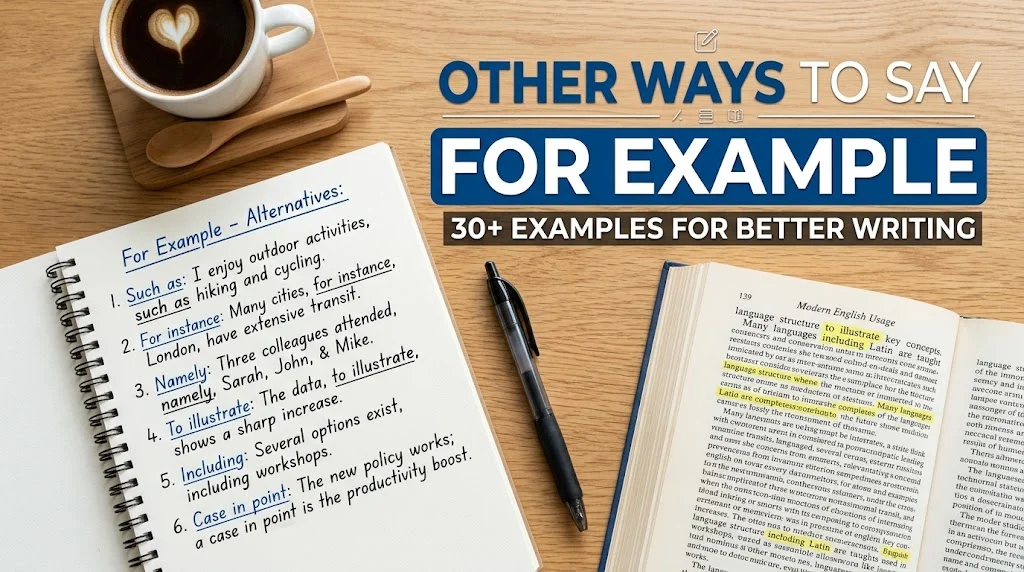
“For example” is a transition phrase used to introduce an illustration or instance. For more variety and precision, try alternatives like “For instance,” “Such as,” “To illustrate,” “Namely,” “Case in point,” or “As an example.”
“For example” is one of the most useful phrases in English. It appears in essays, presentations, emails, and everyday conversation. It signals that a specific instance is about to follow, making abstract ideas concrete and easy to understand. Because it is so versatile, many learners use it in every sentence that needs an illustration.
This guide provides 30 practical alternatives with meanings, examples, and clear notes on formality. You will learn to express excitement in English when introducing a striking example and use professional reaction phrases that make your writing sound polished. Whether you are writing an academic paper, a business report, or a casual message, these options will strengthen your communication.
Pull Quote: “A transition phrase is a signpost. The right one guides the reader; the wrong one makes them stop.”
Quick Categories
Formal alternatives to “For example”
- For instance
- To illustrate
- Namely
- As an illustration
Pro Tip: Formal alternatives suit academic writing, reports, and official documents.
Casual alternatives
- Like
- Say
- Take
- Imagine
Pro Tip: Casual options work in spoken English and informal messages.
Professional alternatives
- For instance
- As a case in point
- To demonstrate
- By way of example
Pro Tip: Professional alternatives should be clear and specific without sounding stiff.
Informal expressions
- For one
- Just to give you an idea
- Here is one
- Take this
Pro Tip: Informal expressions belong in conversations, texts, and relaxed team chats.
Pull Quote: “The right tone makes your English sound professional and confident.”
Common Mistakes
- Using “for example” at the start of every sentence.
Example: “For example, sales rose. For example, costs fell. For example, profits doubled.” Repetition weakens flow. - Following it with a list instead of a single example.
Example: “For example, apples, oranges, and bananas.” The phrase usually introduces one clear instance. - Using it in a sentence that does not need an example.
Example: “For example, I went to the shop.” The statement is not an illustration of anything. - Mixing it with another transition.
Example: “For example, however, sales rose.” Two transitions compete. - Using “like” in formal writing.
Example: “Many fruits, like, apples and pears, are healthy.” The casual filler sounds out of place.
What Does “For Example” Mean?
Definition
It is a transition phrase used to introduce a specific instance that illustrates a general statement.
Grammar Explanation
“For” is a preposition, and “example” is a noun. The phrase functions as a parenthetical or introductory adverbial. It is usually followed by a comma when it begins a sentence.
Example Sentence
“Many countries have adopted the policy. For example, Canada introduced it in 2019.”
When to Use “For Example”
Common Contexts
- Academic writing: Supporting an argument with evidence.
- Business reports: Illustrating a trend or outcome.
- Presentations: Making a concept concrete.
- Everyday conversation: Giving a specific instance.
- Instructional writing: Clarifying a rule or process.
Spoken vs Written
- Spoken: Very common in explanations and discussions.
- Written: Extremely common in essays, reports, and articles.
Formal vs Informal
- Formal: Standard in academic and professional writing.
- Informal: Acceptable in conversation but often replaced by “like” or “say.”
Is It Professional or Polite to Say “For Example”?
Politeness vs Professionalism
The phrase is both polite and professional. It is widely accepted in all registers. However, overuse can make writing feel repetitive, so varying your transitions strengthens your message.
Business-Style Example
“Several markets exceeded expectations. For instance, the German division grew by twelve percent.”
Polite? Yes
Professional? Yes, in most contexts
Pull Quote: “Variety in transitions is a mark of mature writing. Repetition is a mark of habit.”
Pros and Cons of Using “For Example”
Pros
- Simple and natural: Widely understood across all English registers.
- Friendly tone: Neutral and accessible.
- Common usage: Recognised in every professional field.
- Easy to understand: Requires no specialist vocabulary.
Cons
- Too informal for work: Rarely an issue, but can sound repetitive in formal writing.
- Overused: Loses impact through repetition.
- Limited emotional range: Cannot express emphasis or surprise.
- Not suitable for formal writing: Acceptable, but precise alternatives often read better.
Other Ways to Say “For Example” (With Examples)
These alternatives will help you sound more fluent, confident, and natural in different situations. Use them according to tone, context, and audience to express excitement, admiration, or approval.
1. For instance
Meaning: A direct synonym for for example.
Explanation: Slightly more formal and equally common.
Example Sentence: “Many cities have banned plastic bags. For instance, Paris introduced the ban in 2016.”
Best Use: Academic, professional
Worst Use: Casual chats
Tone: Formal, neutral, standard
Context Variability: Professional and written
2. Such as
Meaning: Introducing a specific item within a category.
Explanation: Used before a noun or list, not a full clause.
Example Sentence: “Citrus fruits, such as oranges and lemons, are rich in vitamin C.”
Best Use: Lists, definitions
Worst Use: Full sentences
Tone: Neutral, precise, standard
Context Variability: Professional and written
3. To illustrate
Meaning: To make something clear with an example.
Explanation: Formal and explanatory.
Example Sentence: “To illustrate, consider the case of a small business owner.”
Best Use: Academic, reports
Worst Use: Casual chats
Tone: Formal, explanatory, clear
Context Variability: Professional and written
4. Namely
Meaning: That is to say, specifically.
Explanation: Used to specify something just mentioned.
Example Sentence: “One student stood out, namely the one who solved the problem first.”
Best Use: Formal writing
Worst Use: Casual speech
Tone: Formal, precise, specific
Context Variability: Professional and written
5. Case in point
Meaning: A specific example that proves a point.
Explanation: Often used after a general statement.
Example Sentence: “The company rewards loyalty. Case in point, the CEO started as an intern.”
Best Use: Business, speeches
Worst Use: Academic essays
Tone: Confident, direct, professional
Context Variability: Professional and spoken
6. As an example
Meaning: A slightly more formal version of the phrase.
Explanation: Often used at the start of a sentence.
Example Sentence: “As an example, consider the recent merger between the two firms.”
Best Use: Business, academic
Worst Use: Casual chats
Tone: Formal, neutral, standard
Context Variability: Professional and written
7. To demonstrate
Meaning: To show clearly with evidence.
Explanation: Formal and persuasive.
Example Sentence: “To demonstrate, let us look at the sales figures from last quarter.”
Best Use: Presentations, reports
Worst Use: Casual texts
Tone: Formal, persuasive, clear
Context Variability: Professional and written
8. By way of example
Meaning: As a way of giving an example.
Explanation: Formal and slightly old fashioned.
Example Sentence: “By way of example, consider the handling of the recent complaint.”
Best Use: Formal letters
Worst Use: Everyday chat
Tone: Formal, traditional, polite
Context Variability: Professional and written
9. As a case in point
Meaning: A specific instance that supports the argument.
Explanation: Strong and evidence based.
Example Sentence: “As a case in point, the Tokyo branch exceeded all targets.”
Best Use: Business, academic
Worst Use: Casual chats
Tone: Formal, confident, analytical
Context Variability: Professional and written
10. Like
Meaning: A casual way to introduce an example.
Explanation: Very common in spoken English.
Example Sentence: “I love citrus fruits, like oranges and grapefruits.”
Best Use: Casual speech
Worst Use: Formal writing
Tone: Casual, relaxed, informal
Context Variability: Casual and spoken
11. Say
Meaning: A casual way to introduce a hypothetical example.
Explanation: Common in conversation.
Example Sentence: “If you need a break, say, next Tuesday, just let me know.”
Best Use: Spoken English
Worst Use: Formal reports
Tone: Casual, conversational, informal
Context Variability: Casual and spoken
12. Take
Meaning: A short way to introduce an example.
Explanation: Often used as “take X, for example.”
Example Sentence: “Take the new policy. It has already reduced costs.”
Best Use: Presentations, speeches
Worst Use: Academic essays
Tone: Direct, conversational, confident
Context Variability: Professional and spoken
13. Imagine
Meaning: Introducing a hypothetical example.
Explanation: Engages the reader’s imagination.
Example Sentence: “Imagine a world where every child has access to clean water.”
Best Use: Speeches, essays
Worst Use: Technical reports
Tone: Engaging, persuasive, creative
Context Variability: Professional and written
14. Consider
Meaning: Asking the reader to think about an example.
Explanation: Formal and inclusive.
Example Sentence: “Consider the case of a small business facing rising costs.”
Best Use: Academic, business
Worst Use: Casual chats
Tone: Formal, thoughtful, inclusive
Context Variability: Professional and written
15. Suppose
Meaning: Introducing a hypothetical situation.
Explanation: Common in academic and technical writing.
Example Sentence: “Suppose a company invests in new software. What happens next?”
Best Use: Academic, technical
Worst Use: Casual conversations
Tone: Formal, hypothetical, analytical
Context Variability: Professional and written
16. Let us say
Meaning: A gentle way to introduce a hypothetical example.
Explanation: Conversational and inclusive.
Example Sentence: “Let us say you have a budget of one thousand dollars.”
Best Use: Teaching, explanations
Worst Use: Formal reports
Tone: Conversational, inclusive, clear
Context Variability: Professional and spoken
17. Specifically
Meaning: Precisely or exactly.
Explanation: Used to narrow down a general statement.
Example Sentence: “We need to improve customer service, specifically response times.”
Best Use: Business, technical
Worst Use: Casual chats
Tone: Formal, precise, direct
Context Variability: Professional and written
18. In particular
Meaning: Especially or specifically.
Explanation: Highlights one item from a group.
Example Sentence: “Some regions performed well, in particular the northern district.”
Best Use: Reports, essays
Worst Use: Casual speech
Tone: Formal, specific, analytical
Context Variability: Professional and written
19. That is
Meaning: Used to clarify or restate.
Explanation: Common in both speech and writing.
Example Sentence: “We need more time, that is, at least two more weeks.”
Best Use: Clarification
Worst Use: Formal introductions
Tone: Neutral, explanatory, standard
Context Variability: Professional and spoken
20. To put it another way
Meaning: Rephrasing for clarity.
Explanation: Helpful when explaining complex ideas.
Example Sentence: “To put it another way, the project is behind schedule.”
Best Use: Explanations
Worst Use: Quick replies
Tone: Explanatory, patient, clear
Context Variability: Professional and spoken
21. In other words
Meaning: Restating something more simply.
Explanation: Common in teaching and explanations.
Example Sentence: “In other words, we need to cut costs without losing quality.”
Best Use: Explanations
Worst Use: Formal reports
Tone: Clear, explanatory, neutral
Context Variability: Professional and spoken
22. As proof
Meaning: Introducing evidence that supports a claim.
Explanation: Persuasive and formal.
Example Sentence: “As proof, look at the increase in repeat customers.”
Best Use: Persuasive writing
Worst Use: Casual chats
Tone: Formal, persuasive, confident
Context Variability: Professional and written
23. As evidence
Meaning: Introducing supporting information.
Explanation: Common in academic and legal writing.
Example Sentence: “As evidence, the study cites three separate trials.”
Best Use: Academic, legal
Worst Use: Casual speech
Tone: Formal, serious, analytical
Context Variability: Professional and written
24. To name one
Meaning: Introducing a single example from many.
Explanation: Simple and direct.
Example Sentence: “Many factors contributed. To name one, the weather was unusually bad.”
Best Use: General writing
Worst Use: Formal reports
Tone: Neutral, direct, simple
Context Variability: Professional and spoken
25. Just to give you an idea
Meaning: A casual way to introduce an example.
Explanation: Friendly and conversational.
Example Sentence: “Just to give you an idea, we received over two hundred applications.”
Best Use: Casual conversations
Worst Use: Formal writing
Tone: Casual, friendly, informal
Context Variability: Casual and spoken
26. Here is one
Meaning: Introducing a single example.
Explanation: Direct and conversational.
Example Sentence: “Here is one: the marketing team doubled engagement last month.”
Best Use: Presentations
Worst Use: Academic essays
Tone: Casual, direct, informal
Context Variability: Casual and spoken
27. Take this
Meaning: Introducing an example for consideration.
Explanation: Short and imperative.
Example Sentence: “Take this: a customer who waits too long will not return.”
Best Use: Speeches, teaching
Worst Use: Formal reports
Tone: Direct, conversational, confident
Context Variability: Professional and spoken
28. One example is
Meaning: A simple and clear way to introduce an example.
Explanation: Neutral and easy to understand.
Example Sentence: “One example is the shift to remote work in the tech industry.”
Best Use: General writing
Worst Use: Creative writing
Tone: Neutral, clear, standard
Context Variability: Professional and written
29. A good illustration is
Meaning: Introducing a strong or clear example.
Explanation: Emphasises the quality of the example.
Example Sentence: “A good illustration is the way the team handled the crisis.”
Best Use: Academic, business
Worst Use: Casual chats
Tone: Formal, evaluative, clear
Context Variability: Professional and written
30. To cite one instance
Meaning: A formal way to introduce a single example.
Explanation: Common in academic and legal writing.
Example Sentence: “To cite one instance, the court ruled in favour of the plaintiff.”
Best Use: Academic, legal
Worst Use: Casual chats
Tone: Formal, precise, serious
Context Variability: Professional and written
Pull Quote: “Professional reaction phrases and precise transitions both show the same thing: you respect the reader’s attention.”
Mini Quiz / Self-Check
- Scenario: You are writing an academic essay and need a formal transition. Which fits best?
- A) Like.
- B) For instance.
- C) Say.
- Scenario: You are explaining a concept to a friend in conversation. Which is most natural?
- A) To illustrate.
- B) Like, imagine you have a budget.
- C) By way of example.
- Scenario: You are writing a business report and want to introduce a specific case. Which is most appropriate?
- A) Case in point.
- B) Just to give you an idea.
- C) Take this.
- Scenario: Which phrase is generally too informal for a formal report?
- A) For instance.
- B) Like.
- C) To illustrate.
Comparison Table: Top Alternatives
| Phrase | Tone | Best Use |
| For instance | Formal, neutral | Academic, professional |
| Such as | Neutral, precise | Lists, definitions |
| To illustrate | Formal, explanatory | Academic, reports |
| Namely | Formal, specific | Formal writing |
| Case in point | Confident, direct | Business, speeches |
| As an example | Formal, neutral | Business, academic |
| Like | Casual, relaxed | Casual speech |
| Specifically | Formal, precise | Business, technical |
| In particular | Formal, analytical | Reports, essays |
| One example is | Neutral, clear | General writing |
FAQs
1. What is a formal alternative to “for example”?
“For instance,” “To illustrate,” and “Namely” are strong formal alternatives suitable for academic writing, reports, and official documents.
2. How do I say “for example” in a business email?
Use “For instance,” “As a case in point,” or “To demonstrate” to keep your writing professional and clear.
3. What can I say instead of “for example” in casual conversation?
“Like,” “Say,” and “Just to give you an idea” are natural and informal alternatives for everyday speech.
4. Is “such as” the same as “for example”?
They are similar, but “such as” is used before a noun or list, while “for example” can introduce a full clause or sentence.
5. What is the difference between “for example” and “namely”?
“For example” introduces one instance among many, while “namely” specifies exactly what was just mentioned.
Conclusion
Learning other ways to say for example gives you the ability to guide your reader with precision and variety. Whether you are writing an academic paper, a business report, or a casual message, the right transition makes your writing clearer and more engaging. These alternatives to for example help you move beyond one overused phrase and into richer, more fluent expression.
Practise by choosing one new transition each week and using it in your writing. Pay close attention to tone and context, because the right phrase depends on the audience and the purpose. With steady practice, these informal expressions in English and their formal counterparts will become part of your everyday fluency.

John Green is an American writer who contributes to QuickResponsess.com, creating clear and practical content on English grammar, vocabulary and everyday language. His goal is to make learning English simple, engaging and easy to apply.