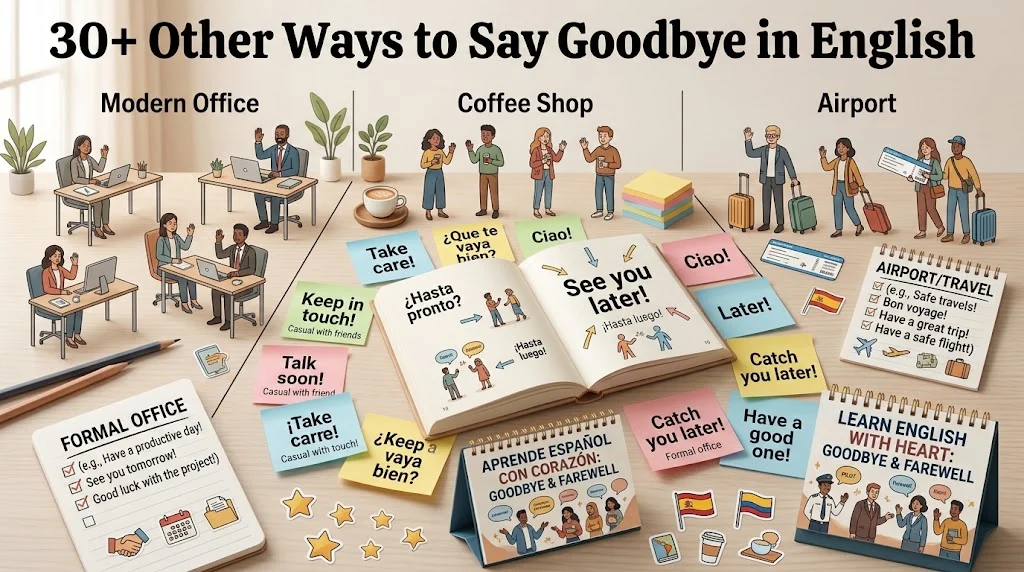
Quick Answer 🔥
Here are 5 top alternatives: Farewell, See you later, Take care, Catch you later, Until next time.
Saying goodbye is something we do every day yet most English learners rely on the same handful of phrases. Goodbye itself is perfectly correct, but using it in every situation can make your English sound repetitive and limited. The truth is, English speakers have dozens of ways to part ways, each carrying a different tone, level of formality, and emotional weight.
Understanding alternatives to goodbye is essential for sounding fluent and natural. Whether you’re ending a business email, saying farewell to a colleague, or waving goodbye to friends, choosing the right phrase shows emotional intelligence and language awareness. It signals that you understand not just the words, but the culture behind them.
Quick Categories
Formal Alternatives to “Goodbye”
- Farewell
- Until we meet again
- I look forward to our next meeting
- All the best
Casual Alternatives
- See you later
- Catch you later
- Bye for now
- Take it easy
Professional Alternatives
- Best regards
- Thank you for your time
- Wishing you all the best
- I appreciate your time
Informal Expressions
- Later!
- Peace out
- I’m off
- Gotta go!
💡 Pro Tip: Match your farewell to your audience. Use formal alternatives with superiors and clients; save casual expressions for friends and close colleagues.
Common Mistakes to Avoid
1. Using “goodbye” in every situation
- ❌ “Goodbye, see you tomorrow!” Too formal for a daily casual farewell.
2. Overusing “bye bye” in professional settings
- ❌ “Bye bye, Mr. Johnson.” Sounds childish and unprofessional.
3. Using slang with people you don’t know well
- ❌ “Peace out, boss!” Inappropriate in most workplace contexts.
4. Forgetting to match tone to context
- ❌ “Farewell, Dave!” for a colleague you’ll see tomorrow overly dramatic.
5. Using “see you later” when you won’t see them
- ❌ “See you later!” to a client you’ll never meet again can feel insincere.
What Does “Goodbye” Mean?
Goodbye is a standard farewell expression used when parting ways. It originated from the phrase “God be with you” and has evolved into the most common way to end a conversation or leave a place.
Grammar note: “Goodbye” functions as an interjection. It can stand alone or be part of a longer sentence.
Example: “Goodbye, everyone. Thank you for coming.”
When to Use “Goodbye”
- Formal written communication letters, official documents
- Telephone conversations with strangers or service providers
- Parting ways when you may not see the person again
- Neutral situations where tone isn’t a priority
Spoken vs Written: More common in spoken English; in writing, professional sign offs are preferred.
Formal vs Informal: “Goodbye” is neutral to formal. It’s rarely used among close friends or family, who prefer casual alternatives.
Is It Professional or Polite to Say “Goodbye”?
Polite? ✔️ Yes It’s universally understood and respectful.
Professional? ❌ No (in most cases) In business writing, “goodbye” feels abrupt and lacks warmth. Professionals prefer sign offs like “Best regards” or “Thank you for your time.”
Business style example: Instead of “Goodbye, looking forward to your reply,” write: “Thank you for your time. I look forward to your response.”
Pros and Cons of Using “Goodbye”
Pros:
- Simple and natural
- Friendly tone
- Common usage understood by all
- Easy to understand
Cons:
- Too informal for work settings
- Overused and unremarkable
- Limited emotional range
- Not suitable for formal writing
💡 “The right tone makes your English sound professional and confident.”
Other Ways to Say “Goodbye” (With Examples)
These alternatives to goodbye will help you sound more fluent, confident, and natural in different situations. Use them according to tone, context, and audience to express warmth in English or maintain professionalism.
1. Phrase: Farewell
Meaning: A formal and somewhat emotional way to say goodbye.
Explanation: Often implies a longer or permanent separation.
Example Sentence: “Farewell, and may our paths cross again someday.”
Best Use: Formal speeches
Worst Use: Casual chats
Tone: Formal, emotional
Context Variability: Formal / written / ceremonial
2. Phrase: See you later
Meaning: A casual promise to meet again soon.
Explanation: One of the most common casual farewells in English.
Example Sentence: “See you later have a great afternoon!”
Best Use: Friends, colleagues
Worst Use: Formal letters
Tone: Friendly, casual
Context Variability: Casual / spoken / everyday
3. Phrase: Take care
Meaning: A warm wish for someone’s well being.
Explanation: Shows you care about the person’s health and safety.
Example Sentence: “Take care, and let me know how everything goes.”
Best Use: Friends, acquaintances
Worst Use: Very formal writing
Tone: Warm, caring
Context Variability: Casual to semi formal / spoken
4. Phrase: Catch you later
Meaning: An informal way to say you’ll see someone again.
Explanation: Very common among friends and younger speakers.
Example Sentence: “Catch you later text me when you’re free.”
Best Use: Friends, peers
Worst Use: Professional emails
Tone: Relaxed, informal
Context Variability: Casual / spoken
5. Phrase: Until next time
Meaning: A hopeful farewell implying future meetings.
Explanation: Warm and optimistic, suitable for various contexts.
Example Sentence: “Until next time I always enjoy our conversations.”
Best Use: Social gatherings, podcasts
Worst Use: Urgent situations
Tone: Warm, optimistic
Context Variability: Casual to semi formal / spoken
6. Phrase: I look forward to our next meeting
Meaning: A professional expression of anticipation.
Explanation: Shows enthusiasm for future collaboration.
Example Sentence: “I look forward to our next meeting have a safe trip home.”
Best Use: Business settings
Worst Use: Friends
Tone: Professional, polite
Context Variability: Formal / written / spoken
7. Phrase: All the best
Meaning: A warm, well wishing farewell.
Explanation: Common in emails and letters to close on a positive note.
Example Sentence: “All the best with your new role you’ll be missed here.”
Best Use: Emails, letters
Worst Use: Very casual texts
Tone: Warm, sincere
Context Variability: Semi formal / written
8. Phrase: Bye for now
Meaning: A temporary farewell.
Explanation: Implies you’ll see or speak to the person again soon.
Example Sentence: “Bye for now talk to you tomorrow!”
Best Use: Friends, family
Worst Use: Formal business
Tone: Friendly, casual
Context Variability: Casual / spoken
9. Phrase: Have a good day
Meaning: A polite, everyday farewell wishing someone well.
Explanation: Extremely common in customer service and daily interactions.
Example Sentence: “Have a good day it was nice meeting you.”
Best Use: Customer service, daily interactions
Worst Use: Emotional farewells
Tone: Polite, neutral
Context Variability: Neutral to formal / spoken
10. Phrase: It was nice seeing you
Meaning: A polite way to end a social encounter.
Explanation: Acknowledges the positive interaction you just had.
Example Sentence: “It was nice seeing you let’s do this again soon.”
Best Use: Social gatherings
Worst Use: Brief encounters
Tone: Warm, polite
Context Variability: Semi formal / spoken
💡 “Alternatives to goodbye show emotional intelligence and cultural awareness.”
11. Phrase: So long
Meaning: An informal, slightly nostalgic farewell.
Explanation: Popular in American English, often implies a longer absence.
Example Sentence: “So long, partner take care of yourself.”
Best Use: Casual, nostalgic moments
Worst Use: Professional settings
Tone: Nostalgic, casual
Context Variability: Casual / spoken
12. Phrase: I’m off
Meaning: A casual way to announce you’re leaving.
Explanation: Very common in British and American informal speech.
Example Sentence: “I’m off see you all tomorrow!”
Best Use: Friends, family, colleagues
Worst Use: Formal situations
Tone: Casual, direct
Context Variability: Casual / spoken
13. Phrase: Take it easy
Meaning: A relaxed farewell wish for someone to stay calm and stress free.
Explanation: Friendly and informal, common among peers.
Example Sentence: “Take it easy I’ll call you next week.”
Best Use: Friends, acquaintances
Worst Use: Professional emails
Tone: Relaxed, friendly
Context Variability: Casual / spoken
14. Phrase: Wishing you all the best
Meaning: A warm, sincere farewell with good wishes.
Explanation: Often used when someone is starting a new chapter.
Example Sentence: “Wishing you all the best in your new job you deserve it.”
Best Use: Farewell messages, emails
Worst Use: Daily conversations
Tone: Sincere, warm
Context Variability: Semi formal / written
15. Phrase: Cheerio
Meaning: A friendly, informal British farewell.
Explanation: Very British; may sound outdated in American English.
Example Sentence: “Cheerio, old chap see you at the pub!”
Best Use: British English, casual
Worst Use: American professional settings
Tone: Cheerful, informal
Context Variability: Casual / spoken (British)
16. Phrase: Ciao
Meaning: An informal Italian farewell adopted globally.
Explanation: Used among friends and in casual international settings.
Example Sentence: “Ciao let’s catch up when you’re back in town.”
Best Use: Friends, international settings
Worst Use: Formal business
Tone: Casual, international
Context Variability: Casual / spoken
17. Phrase: Later!
Meaning: A very casual, abbreviated farewell.
Explanation: Common among younger speakers and in text messages.
Example Sentence: “Later! Thanks for hanging out.”
Best Use: Friends, text messages
Worst Use: Any formal context
Tone: Very casual
Context Variability: Casual / spoken / text
18. Phrase: Until we meet again
Meaning: A poetic and hopeful farewell.
Explanation: Often used in emotional or ceremonial contexts.
Example Sentence: “Until we meet again you’ll always be in my thoughts.”
Best Use: Emotional farewells, letters
Worst Use: Daily conversations
Tone: Emotional, poetic
Context Variability: Formal to emotional / written
19. Phrase: Have a good one
Meaning: A casual, friendly farewell.
Explanation: Very common in American English; “one” refers to the day.
Example Sentence: “Have a good one see you around!”
Best Use: Daily interactions, casual
Worst Use: Formal writing
Tone: Friendly, casual
Context Variability: Casual / spoken
20. Phrase: I must be going
Meaning: A polite way to announce you need to leave.
Explanation: Softens the departure and shows consideration.
Example Sentence: “I must be going it’s getting late.”
Best Use: Social situations, meetings
Worst Use: Text messages
Tone: Polite, considerate
Context Variability: Semi formal / spoken
💡 “Using the right farewell shows you understand both language and culture.”
21. Phrase: Thank you for your time
Meaning: A professional way to end a meeting or interaction.
Explanation: Expresses gratitude while closing the conversation.
Example Sentence: “Thank you for your time I’ll follow up with an email.”
Best Use: Business meetings, client calls
Worst Use: Friends, casual settings
Tone: Professional, grateful
Context Variability: Formal / written / spoken
22. Phrase: See you around
Meaning: A casual farewell implying you’ll meet again by chance.
Explanation: Less specific than “see you later” more open ended.
Example Sentence: “See you around take care of yourself.”
Best Use: Casual, open ended farewells
Worst Use: Formal contexts
Tone: Casual, friendly
Context Variability: Casual / spoken
23. Phrase: Bye bye
Meaning: A playful, childlike farewell.
Explanation: Mostly used with children or in very casual, affectionate settings.
Example Sentence: “Bye bye, sweetheart have a great day at school.”
Best Use: Children, close family
Worst Use: Any professional context
Tone: Playful, affectionate
Context Variability: Casual / spoken
24. Phrase: Peace out
Meaning: A slang farewell popular in the 1990s and still used informally.
Explanation: Very informal; best used with close friends.
Example Sentence: “Peace out, guys see you tomorrow.”
Best Use: Close friends, casual
Worst Use: Any formal or professional setting
Tone: Slang, casual
Context Variability: Casual / spoken
25. Phrase: Gotta go!
Meaning: An abrupt, informal way to say you need to leave.
Explanation: Implies urgency or that you’re running late.
Example Sentence: “Gotta go my train’s here!”
Best Use: Urgent situations, friends
Worst Use: Professional settings
Tone: Urgent, casual
Context Variability: Casual / spoken
26. Phrase: I appreciate your time
Meaning: A professional and grateful farewell.
Explanation: Shows respect for the other person’s schedule.
Example Sentence: “I appreciate your time have a wonderful rest of your day.”
Best Use: Business meetings, consultations
Worst Use: Casual conversations
Tone: Professional, appreciative
Context Variability: Formal / spoken / written
27. Phrase: See you soon
Meaning: A friendly farewell implying a near future meeting.
Explanation: More specific than “see you later” implies soon.
Example Sentence: “See you soon I can’t wait to catch up.”
Best Use: Friends, family, colleagues
Worst Use: Formal letters
Tone: Friendly, optimistic
Context Variability: Casual to semi formal / spoken
28. Phrase: Adieu
Meaning: A very formal, often final French farewell.
Explanation: Carries emotional weight; implies you may not meet again.
Example Sentence: “Adieu, my friend I wish you nothing but happiness.”
Best Use: Emotional, formal farewells
Worst Use: Daily conversations
Tone: Formal, emotional
Context Variability: Formal / written
29. Phrase: Have a pleasant day
Meaning: A polite, slightly formal farewell.
Explanation: More formal than “have a good day.”
Example Sentence: “Have a pleasant day it was a pleasure speaking with you.”
Best Use: Customer service, formal interactions
Worst Use: Friends, family
Tone: Polite, formal
Context Variability: Formal / spoken
30. Phrase: Till we meet again
Meaning: A warm, hopeful farewell similar to “until we meet again.”
Explanation: Slightly more casual but still emotional.
Example Sentence: “Till we meet again keep in touch!”
Best Use: Emotional farewells, letters
Worst Use: Daily interactions
Tone: Warm, hopeful
Context Variability: Semi formal / written
💡 “Mastering professional reaction phrases elevates your business English instantly.”
Mini Quiz / Self Check
1. Which farewell is most appropriate for a job interview closing?
- A) Peace out
- B) Thank you for your time
- C) Later!
- D) Bye bye
Answer: B “Thank you for your time” is professional and respectful.
2. You’re leaving a friend’s house after dinner. Which is most natural?
- A) Farewell
- B) Adieu
- C) See you later
- D) I appreciate your time
Answer: C “See you later” is casual and friendly.
3. Which phrase implies you may not see the person again?
- A) See you soon
- B) Catch you later
- C) Farewell
- D) Bye for now
Answer: C “Farewell” often implies a longer or final separation.
4. You’re ending a formal email to a client. Which sign off is best?
- A) Cheerio
- B) All the best
- C) Peace out
- D) Gotta go
Answer: B “All the best” is warm yet professional.
Comparison Table: Top 10 Alternatives
| Phrase | Tone | Best Use |
| Farewell | Formal, emotional | Ceremonial farewells |
| See you later | Casual, friendly | Friends and colleagues |
| Take care | Warm, caring | Any casual to semi formal setting |
| All the best | Warm, sincere | Emails, letters |
| Thank you for your time | Professional, grateful | Business meetings, client calls |
| Catch you later | Relaxed, informal | Friends, peers |
| Until next time | Warm, optimistic | Social gatherings |
| I look forward to our next meeting | Professional, anticipatory | Business settings |
| Have a good day | Polite, neutral | Daily interactions |
| Wishing you all the best | Sincere, warm | Farewell messages |
FAQs
1. What are some formal ways to say goodbye in English?
Formal alternatives include “Farewell,” “Until we meet again,” “I look forward to our next meeting,” and “All the best.” These are appropriate for business emails, speeches, and professional correspondence.
2. What is a professional way to say goodbye in an email?
Professional email sign offs include “Best regards,” “Sincerely,” “Thank you for your time,” and “Wishing you all the best.” Avoid using “Goodbye” or “Bye” in formal business emails.
3. What are casual ways to say goodbye to friends?
Casual alternatives include “See you later,” “Catch you later,” “Take it easy,” “Later!” and “I’m off.” These are perfect for friends, family, and informal settings.
4. Is “goodbye” formal or informal?
“Goodbye” is neutral to formal. It’s appropriate in most situations but can feel too stiff for close friends and too abrupt for professional emails. Learning other ways to say goodbye helps you match the right tone to every context.
5. What is the most common way to say goodbye in English?
“Bye” is the most common and widely used farewell in everyday English. It’s simple, friendly, and appropriate for most casual situations. For professional settings, “Best regards” or “Thank you” are more common.
Conclusion
Mastering alternatives to goodbye is one of the simplest ways to elevate your English fluency. By moving beyond the basic “goodbye,” you gain the ability to match your tone to any situation whether you’re writing a professional email, chatting with friends, or delivering a heartfelt farewell. Each alternative carries its own nuance, and using the right one shows emotional intelligence and cultural awareness.
Start practicing today. Pick two or three alternatives from this list and use them in your daily conversations. Pay attention to how native speakers say goodbye in different contexts, and soon you’ll express warmth in English naturally and confidently. Remember: the right farewell leaves a lasting impression.

John Green is an American writer who contributes to QuickResponsess.com, creating clear and practical content on English grammar, vocabulary and everyday language. His goal is to make learning English simple, engaging and easy to apply.